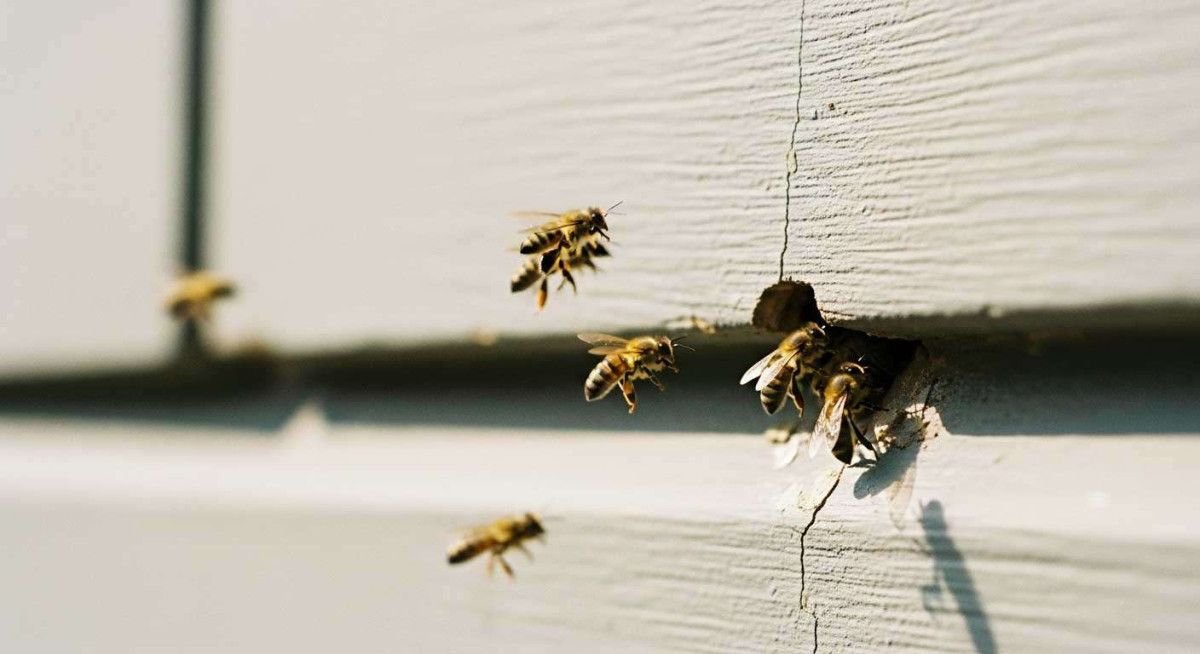
How you get rid of bees depends entirely on what kind of bee you have. If the insect is a honeybee — golden-brown, fuzzy, roughly 1/2 inch long, living in a visible colony of thousands inside a wall, a tree, or a hive box — you do not kill them. You call a beekeeper, who will remove the colony alive and relocate it. Honeybee populations have declined by roughly 30% to 40% in the last two decades due to colony collapse disorder, pesticides, and habitat loss, and killing a honeybee colony is environmentally destructive, illegal in some states, and unnecessary — beekeepers will remove them for free or for a modest fee. If the insect is a wasp, hornet, or yellowjacket — slender, shiny, with little or no hair, living in a paper nest or a ground cavity — you can kill them yourself with an aerosol insecticide labeled for wasps and hornets, applied at night when the entire colony is in the nest. The identification determines the treatment. Kill the wasps. Save the bees. Get the identification right.
The word “bee” is used generically for any stinging insect, but the treatment for honeybees and the treatment for wasps are opposites. A honeybee colony can be removed alive, and the bees will not return to the same cavity once the comb and the pheromones are removed. A wasp nest can be sprayed and destroyed, and a new queen will rebuild in the same location the following spring if the nest is not physically removed after treatment. A honeybee swarm — a football-sized cluster of bees hanging from a tree branch, a fence, or the eaves of a house — is not a threat. It is a colony in transit, resting while scout bees search for a permanent home. The swarm will leave on its own within 24 to 72 hours. Do not spray it. Call a beekeeper, or wait.
Contents
- 1 Step 1: Identify What You Have — Honeybee, Bumblebee, Wasp, Hornet, or Yellowjacket
- 2 Honeybees in a Wall: Do Not Spray Them, Do Not Seal the Entrance
- 3 Wasps, Hornets, and Yellowjackets: How to Kill the Nest Safely
- 4 Prevention: Keep New Nests From Forming
- 5 FAQ: Common Questions About Bee Removal
- 6 Identify the Insect. Save the Bees. Kill the Wasps. Call a Professional If You Are Not Certain.
Step 1: Identify What You Have — Honeybee, Bumblebee, Wasp, Hornet, or Yellowjacket
| Insect | Appearance | Nest Location | Aggressiveness | Treatment |
| Honeybee | Golden-brown, fuzzy, thick-bodied | Wall cavities, hollow trees, hive boxes — visible wax comb | Low — only stings when nest is threatened | Live removal by beekeeper |
| Bumblebee | Large, round, fuzzy, black and yellow | Ground cavities, old rodent burrows, compost piles | Low — only stings when nest is disturbed | Leave alone if possible — beneficial pollinator; relocate if necessary |
| Wasp (paper wasp) | Slender, smooth, long legs, reddish-brown | Open paper comb under eaves, porch ceilings, window frames | Moderate — stings when nest is approached | Wasp spray at night; remove nest |
| Hornet (bald-faced hornet) | Large, black with white face, smooth | Large paper nest in trees, shrubs, eaves — grey, football-shaped | High — aggressively defends nest | Wasp spray at night from a distance; professional removal for high nests |
| Yellowjacket | Small, yellow and black, smooth, short | Ground cavities, wall voids, attics — often enters through a small hole | Very high — aggressively defends nest, stings repeatedly | Dust insecticide into the nest entrance at night; do not seal the entrance |
Honeybees in a Wall: Do Not Spray Them, Do Not Seal the Entrance
A honeybee colony inside a wall cavity is a structural as well as a biological problem. The colony consists of 20,000 to 60,000 bees, multiple sheets of wax comb filled with honey and brood, and the queen. Spraying a can of wasp killer into the entrance kills a few hundred guard bees and drives the rest of the colony deeper into the wall — where they die, and the comb, the honey, and the brood rot. The rotting comb produces a smell that attracts ants, roaches, and mice. The honey, no longer cooled by the bees’ wing-fanning, melts and drips through the drywall. A dead bee colony in a wall is a far more expensive problem than a live one.
Do not seal the entrance hole. The bees will find another exit — potentially into the living space — or they will die inside the wall, producing the same rotting-comb problem. An experienced beekeeper will perform a cut-out: opening the wall from the exterior or interior, removing the comb and the bees alive, vacuuming the remaining bees, and sealing the cavity. The beekeeper then patches the wall opening. The cost is $300 to $1,000, depending on the complexity of the cut-out. The wall repair is additional — typically $200 to $800 if the beekeeper does not perform it. The total cost of a live bee removal from a wall is $500 to $1,800. The cost of spraying the colony and leaving it to rot — plus the subsequent pest infestation, drywall replacement, and honey damage — is $2,000 to $5,000. The live removal is cheaper.
To find a beekeeper, search for “beekeepers association” plus your county name, or “swarm removal” plus your city. Most counties have a beekeeping association with a swarm hotline. The beekeeper will ask for photographs to confirm the insects are honeybees, not wasps. A swarm hanging in a tree costs $0 to $150 to remove — the beekeeper gets a free colony of bees, and you get the swarm removed. A colony inside a wall costs $300 to $1,000 for the cut-out plus the wall repair.
Wasps, Hornets, and Yellowjackets: How to Kill the Nest Safely
Above-Ground Nests (Paper Wasps, Hornets)
Purchase an aerosol wasp and hornet spray that propels a jet of insecticide 15 to 20 feet. Do not use a general-purpose insecticide — wasp spray is formulated to knock down stinging insects on contact and to kill the entire colony quickly. Treat the nest at night — after dark, when all the wasps are inside the nest and are inactive. Wear long sleeves, long pants, gloves, and eye protection. Stand at the maximum distance the spray can reach — 15 to 20 feet — and aim at the nest entrance. Spray for 3 to 5 seconds, thoroughly soaking the nest entrance and the body of the nest. Leave immediately after spraying. Do not return to check the nest for at least 24 hours. The next day, observe the nest from a distance. If no wasps are entering or leaving, knock the nest down with a long pole and dispose of it in a sealed trash bag. If wasps are still active, re-treat the following night.
Ground Nests (Yellowjackets)
Locate the nest entrance — a small hole in the ground, typically 1 to 2 inches in diameter, with yellowjackets flying in and out. At night, apply an insecticidal dust — carbaryl, permethrin, or diatomaceous earth — liberally into the entrance hole. Do not use a liquid spray — liquid does not penetrate the nest tunnels. Do not seal the entrance — the yellowjackets will dig a new exit, potentially into the living space. The dust adheres to the yellowjackets’ bodies as they enter and leave the nest, and they carry it to the queen and the brood. The colony dies within 24 to 48 hours. After confirming the nest is dead — no activity for 48 hours — fill the entrance hole with soil.
Do Not Use Gasoline on Ground Nests
Pouring gasoline into a yellowjacket nest entrance is a folk remedy that is extremely dangerous — the gasoline does not reliably kill the colony, it contaminates the soil and groundwater, it is a fire hazard, and the fumes can travel through the nest tunnels and accumulate in enclosed spaces. There is no safe use of gasoline as a pesticide. Use insecticidal dust instead.
Prevention: Keep New Nests From Forming
- Seal gaps in the exterior of the house. Caulk or expanding foam around gaps in siding, around window and door frames, and around utility penetrations. Bees and wasps enter through holes as small as 3/8 inch.
- Remove old nests after treatment. Wasps are attracted to the pheromones left on old nests. A vacant nest signals to a new queen that the location was successful for another colony.
- Fill ground cavities. Old rodent burrows are the preferred nesting site for bumblebees and yellowjackets. Fill them with soil and tamp it down.
- Reduce outdoor food sources. Yellowjackets are attracted to protein and sugar — pet food left outside, open garbage cans, fallen fruit from trees, and sugary drinks at outdoor gatherings.
FAQ: Common Questions About Bee Removal
Can I get honeybees removed for free?
Yes — for a swarm, almost certainly. A honeybee swarm hanging from a tree branch or a fence is a free colony for a beekeeper. The beekeeper captures the swarm and takes it to an apiary. Swarm removal is typically free. A colony inside a wall or a structure is not free — the labor to cut into the wall, remove the comb, and extract the bees is substantial, and the beekeeper charges for that labor. The bees themselves are a byproduct of the work, not the primary value.
What if I am allergic to bee stings — should I attempt any of this myself?
No. If you have a known allergy to bee or wasp stings — anaphylaxis, swelling of the throat, difficulty breathing — do not attempt to treat any stinging insect nest yourself. Call a professional. An allergic reaction to a sting while standing on a ladder treating an above-ground nest is a medical emergency in a location where emergency services cannot reach you quickly. The cost of a professional wasp or bee removal — $150 to $500 — is less than the cost of an emergency room visit for anaphylaxis.
Identify the Insect. Save the Bees. Kill the Wasps. Call a Professional If You Are Not Certain.
Getting rid of bees requires identifying whether the insect is a honeybee — which should be removed alive by a beekeeper — or a wasp, hornet, or yellowjacket — which can be safely killed with insecticide applied at night. Honeybees in a wall cost $500 to $1,800 to remove alive, which is less than the cost of killing them and repairing the damage. Wasps and hornets are treated with a jet spray at night from a distance. Yellowjackets in the ground are treated with dust, not liquid, and the entrance is not sealed. If you are not certain what insect you have, or if you are allergic to stings, call a professional. The cost of the call is less than the cost of a mistake.