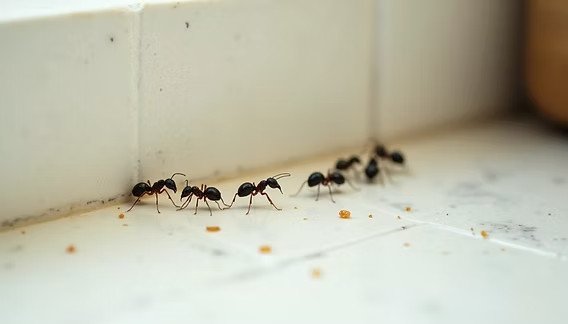
The only way to permanently get rid of carpenter ants is to find and destroy the parent colony — the nest where the queen lives and produces eggs. Killing the ants you see on the kitchen counter, in the bathroom, or trailing along the baseboard eliminates the foragers but leaves the colony intact to produce more ants — indefinitely. Carpenter ants are not like sugar ants or pavement ants that can be controlled by wiping down surfaces and setting out bait stations. Carpenter ants excavate nests inside wood — typically damp, decaying wood in wall cavities, window frames, roof eaves, deck joists, or tree stumps — and the nest must be located and treated directly, or the ants will continue to emerge from it for years.
Carpenter ants are the largest ants in North America — workers range from 1/4 inch to 1/2 inch long, and the winged reproductives (swarmers) can reach 3/4 inch. They are black, red, or a combination of black and red, depending on the species. They do not eat wood. Unlike termites, which digest cellulose, carpenter ants excavate wood to create smooth, clean galleries for nesting — tunnels and chambers that follow the wood grain. They push the sawdust-like wood shavings — called frass — out of the nest through small kick-out holes. The frass pile beneath a kick-out hole is the single most reliable sign of an active carpenter ant nest inside the structure. If you find a small pile of what looks like coarse sawdust on the floor, the windowsill, or the basement floor, and there is a small hole in the wood directly above or behind it, you have found the nest.
Contents
- 1 Step 1: Confirm You Have Carpenter Ants — Not Termites
- 2 Step 2: Find the Nest — Parent Colony and Satellite Nests
- 3 Step 3: Treat the Nest — Products and Methods
- 4 Prevention: Eliminate the Conditions Carpenter Ants Require
- 5 FAQ: Common Questions About Carpenter Ant Control
- 6 Find the Nest. Kill the Queen. Fix the Moisture.
Step 1: Confirm You Have Carpenter Ants — Not Termites
| Feature | Carpenter Ants | Termites |
| Body shape | Three distinct body segments with a narrow, pinched waist | Two body segments with a thick, straight waist |
| Antennae | Elbowed — bent at a sharp angle | Straight — like a string of tiny beads |
| Wings (if present) | Front wings longer than back wings; wings are clear or smoky | All four wings equal in length; wings are milky white |
| Frass (debris pushed out of nest) | Coarse sawdust mixed with insect body parts, soil, and debris | Fine, uniform pellets — no sawdust, no insect parts |
| Wood damage | Smooth, clean galleries — looks sanded inside; no mud | Rough galleries packed with mud and soil |
The distinction matters because carpenter ants and termites require entirely different treatments. Spraying a carpenter ant nest with a general insecticide kills the exposed workers but does not reach the queen — and may scatter the colony into multiple satellite nests throughout the house. Treating carpenter ants incorrectly can make the problem worse. Termites require professional treatment in virtually every case. Carpenter ants can be eliminated by a homeowner who is willing to locate the nest and apply the correct insecticide directly.
Step 2: Find the Nest — Parent Colony and Satellite Nests
Carpenter ants typically have one parent colony — containing the queen, the eggs, and the larvae — located outside the house in a tree stump, a woodpile, a fence post, or a landscape timber. The parent colony must be in a location with consistent moisture because the eggs and larvae need humidity to survive. The ants you see inside the house are usually from satellite nests — secondary colonies established in the wall voids, roof eaves, window frames, or hollow-core doors of the house. Satellite nests do not contain a queen. They contain workers, pupae, and mature larvae brought in from the parent colony. Eliminating the satellite nests without eliminating the parent colony is a temporary measure — the parent colony will establish new satellite nests within months.
To find the satellite nests, follow the ants. Carpenter ants are most active at night, between roughly 10 PM and 2 AM. Turn off the lights. Use a flashlight with a red filter — red light is invisible to ants and does not disturb their behavior. Watch where the workers go. They will eventually lead you back to the nest. The trail may lead outside — in which case the ants are traveling between the outdoor parent colony and an indoor food source. The trail may lead into the wall — in which case the satellite nest is inside the wall cavity. Tap on the wall, the window frame, or the baseboard along the trail. A wall cavity containing a satellite nest will produce a hollow, slightly crunchy sound when tapped — the sound of the ants rustling inside their galleries. The nest location will also feel warm to the touch compared to the surrounding wall because the ants generate metabolic heat.
The frass pile is the best daytime indicator of a nest location. During daylight hours, look for small piles of sawdust-like debris — frass — beneath tiny holes in wood surfaces. The frass is pushed out of the nest by the workers. The hole above the pile is the kick-out hole, and the nest is directly behind or above it. A frass pile that reappears after you sweep it up is the confirmation of an active colony.
Step 3: Treat the Nest — Products and Methods
| Treatment Method | How It Works | Best For | Kills the Queen? |
| Insecticidal dust (diatomaceous earth, boric acid, deltamethrin dust) | Injected directly into the nest cavity through the kick-out hole or a drilled access hole. Dust adheres to ants’ bodies; ants carry it through the colony, spreading it to the queen. | Satellite nests inside wall voids — can reach the queen if dust is carried to the parent colony | ⚠️ Yes — if workers carry dust back to parent colony |
| Non-repellent liquid spray (fipronil, imidacloprid) | Sprayed around the foundation perimeter and at nest entry points. Ants walk through it, carry it back to the colony on their bodies, and spread it through grooming and food sharing. | Perimeter defense — kills foraging ants and slowly poisons the colony through transfer | ✅ Yes — transferred to queen through trophallaxis (food sharing) |
| Gel or granular bait (borax-based, hydramethylnon, indoxacarb) | Placed along ant trails. Workers carry bait back to the colony and feed it to the queen and larvae. Death is delayed — 24 to 72 hours — to allow the bait to reach the queen. | Parent colony outside and satellite nests inside — bait reaches both | ✅ Yes — fed directly to queen |
| Direct injection of aerosol or foam (pyrethrin, d-limonene) | Aerosol injected directly into the nest cavity through the kick-out hole. Kills ants on contact. Does not reach the queen unless injected directly into the parent colony. | Confirmed satellite nest — immediate elimination of that nest | ❌ No — unless parent colony is injected |
The most effective strategy for an established carpenter ant infestation is a combination approach: a non-repellent liquid barrier around the foundation to intercept incoming foragers and transfer the insecticide back to the colony, gel bait stations along the trails to poison the colony through food sharing, and insecticidal dust blown directly into any accessible satellite nest cavities through the kick-out holes. The combination kills ants on contact, kills through transfer, and kills through ingestion. One method alone may not reach the queen. Three methods together almost certainly will.
Do Not Spray the Ant Trail With a Repellent Insecticide
A repellent spray — the kind that kills ants on contact and leaves a chemical barrier that ants will not cross — traps the foragers inside the nest. The ants cannot return to the parent colony, and the foragers inside the satellite nest are cut off from the queen. This does not eliminate the colony. It splits it into isolated fragments, each of which may establish its own queen and become an independent colony. The result is more colonies, not fewer. Use only non-repellent insecticides for carpenter ant treatment — the ants should not detect the insecticide as they walk through it.
Prevention: Eliminate the Conditions Carpenter Ants Require
Carpenter ants are attracted to moisture. The parent colony requires damp, decaying wood to survive. The most effective long-term prevention is to eliminate moisture problems in and around the house: repair leaking roofs, gutters, and downspouts that keep the roof eaves and the foundation damp; repair plumbing leaks under sinks and in crawlspaces; replace water-damaged wood in window frames, door frames, and deck joists; store firewood at least 20 feet from the house and elevated off the ground; trim tree branches that touch the roof — ants use branches as highways from the tree canopy to the house; and seal cracks and gaps in the foundation, around utility penetrations, and around windows and doors.
FAQ: Common Questions About Carpenter Ant Control
When should I call a professional for carpenter ants?
Call a professional when you cannot locate the nest after one to two weeks of searching, when the infestation is widespread — ants in multiple rooms or on multiple floors — when the nest is in an inaccessible location (inside a cathedral ceiling, under a concrete slab), or when you see winged swarmers emerging from inside the house. Swarmers from inside the house mean the colony is mature — at least 3 to 5 years old — and large enough to produce reproductives. Professional treatment costs $250 to $500 for a targeted nest treatment and $500 to $1,500 for a whole-structure treatment with a non-repellent perimeter barrier and direct nest injection.
How much damage can carpenter ants do to a house?
Over a period of years, significant structural damage. Carpenter ants do not eat wood, so the damage accumulates more slowly than termite damage — but a colony that has been active for 5 to 10 years can hollow out enough wood in wall studs, floor joists, and roof rafters to require structural repair. The damage is typically concentrated in areas with persistent moisture — the sill plate above the foundation, the roof eaves beneath a leaking gutter, the wall cavity around a leaking window. The ants do not tunnel through dry wood. The moisture problem creates the opening. The ants exploit it. Fix the moisture, and the ants will not return.
Find the Nest. Kill the Queen. Fix the Moisture.
Getting rid of carpenter ants requires finding the colony, killing the queen, and eliminating the moisture that attracted them. Killing the foragers on the kitchen counter does nothing. The colony lives in a tree stump in the yard or in the wall cavity behind the bathroom. Find it by following the ants at night with a flashlight. Treat it with a combination of non-repellent barrier spray, gel bait, and insecticidal dust injected into the nest. Fix the leak that created the damp wood. The ants are a symptom. The moisture is the cause.