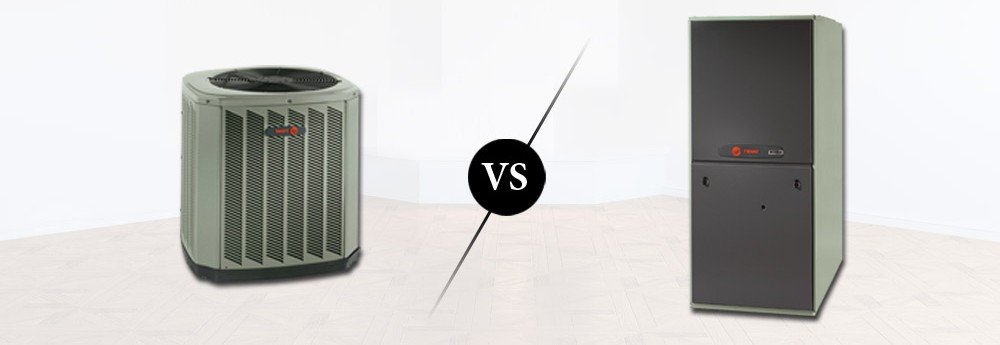
A heat pump and a gas furnace are fundamentally different heating technologies. A gas furnace burns fuel to create heat — one unit of natural gas produces roughly 0.80 to 0.98 units of heat depending on the furnace’s AFUE rating. A heat pump moves heat from outside to inside — one unit of electricity moves 2 to 4 units of heat, depending on the outdoor temperature. The gas furnace is more expensive to operate in mild climates. The heat pump loses capacity and efficiency as outdoor temperatures drop and cannot produce enough heat in very cold climates without backup. The choice between them is primarily a climate decision, and secondarily a fuel-cost decision.
The U.S. Department of Energy classifies high-efficiency gas furnaces at “90% to 98.5% AFUE” and recommends sealed combustion models that “bring outside air directly into the burner” (energy.gov). Heat pumps are regulated by a different metric — the Heating Seasonal Performance Factor (HSPF) — which measures efficiency over an entire heating season. A gas furnace at 95% AFUE converts 95% of its fuel into heat regardless of the outdoor temperature. A heat pump with an HSPF of 10 produces 10 BTU of heat per watt-hour of electricity over a typical heating season, but the instantaneous efficiency drops as the outdoor temperature falls. At 47°F, the heat pump may operate at a coefficient of performance (COP) of 3.5 to 4.0. At 17°F, the COP drops to 2.0 to 2.5. At -5°F, the COP may be 1.2 to 1.5 — barely better than an electric furnace’s COP of 1.0.
Contents
Heat Pump vs. Gas Furnace: Quick Comparison
| Feature | Heat Pump | Gas Furnace |
| How it works | Moves heat from outside to inside | Burns natural gas or propane to create heat |
| Efficiency metric | HSPF / COP | AFUE |
| Typical efficiency | HSPF 8-13, COP 2-4 (varies with outdoor temp) | 80-98.5% AFUE (constant) |
| Installation cost | $4,000-$12,000 (air-source, ducted) | $3,500-$12,000 |
| Annual operating cost (2,000 sq ft, mixed climate) | $800-$1,500 | $600-$1,200 (natural gas) |
| Lifespan | 12-18 years | 15-25 years |
| Provides air conditioning? | ✅ Yes — same unit | ❌ No — requires separate AC |
| Best climate | Mild to moderate (zones 1-4) | Cold to very cold (zones 5-7) |
Heat Pump Pros: 4 Reasons to Choose One
1. One Unit Does Heating and Cooling
A heat pump is an air conditioner that can run in reverse. In summer, it moves heat from inside to outside — cooling the house. In winter, it reverses the refrigerant cycle and moves heat from outside to inside — heating the house. One unit, one installation, one set of ducts, one thermostat. A gas furnace heats only and must be paired with a separate air conditioner for cooling. The heat pump eliminates the need for two separate systems.
2. Lower Operating Cost in Mild Climates
In climate zones where winter temperatures rarely drop below 30°F, the heat pump operates at a COP of 3.0 to 4.0 for most of the heating season. At the national average residential electricity rate of roughly $0.15 per kWh and a COP of 3.5, the cost per million BTU of heat from a heat pump is roughly $13. A 95% AFUE gas furnace at $1.20 per therm costs roughly $12 per million BTU. In mild climates where the heat pump’s COP stays high and electricity rates are moderate, the heat pump’s operating cost is comparable to or slightly lower than a gas furnace.
3. No Combustion, No Carbon Monoxide, No Gas Line
A heat pump has no burner, no flame, no combustion gases, and no carbon monoxide risk. It requires no gas line, no vent pipe, and no chimney. The absence of combustion eliminates the safety risks and the maintenance requirements associated with burning fuel inside a house. The DOE recommends that “every home have a working carbon monoxide alarm” (energy.gov) specifically because of combustion appliances like gas furnaces. A heat pump makes the CO alarm a precaution, not a necessity.
4. Eligible for Larger Tax Credits
Heat pumps qualify for a federal tax credit of 30% of the installed cost, up to $2,000, under the 25C Energy Efficient Home Improvement Credit. A gas furnace qualifies for up to $600 and only at 97% AFUE or higher. The heat pump tax credit is three times larger and applies to a wider range of qualifying equipment.
Heat Pump Cons: 4 Reasons to Go With Gas Instead
1. Loses Capacity and Efficiency in Cold Weather
This is the heat pump’s fundamental limitation. As the outdoor temperature drops, the heat pump’s ability to extract heat from the outside air decreases. At 47°F, a typical air-source heat pump delivers 100% of its rated capacity at a COP of 3.5 to 4.0. At 17°F, it delivers roughly 70% to 80% of its rated capacity at a COP of 2.0 to 2.5. At -5°F, it delivers roughly 50% to 60% of its rated capacity at a COP of 1.2 to 1.5. In very cold climates — zones 5 through 7 — a heat pump alone cannot keep up with the house’s heat loss on the coldest days. A backup heat source — electric resistance strips inside the air handler or a gas furnace in a dual-fuel system — is required.
2. Cooler Supply Air Temperature
A gas furnace delivers supply air at 110°F to 130°F — hot air that feels warm immediately. A heat pump delivers supply air at 85°F to 95°F — warm but noticeably cooler than body temperature. The air heats the room, but it does not feel warm when you hold your hand over the register. Some people experience this as drafts or insufficient heating, even when the system is performing correctly. The cooler air is a comfort preference issue, not a performance issue.
3. Higher Upfront Cost Than a Gas Furnace Alone
A heat pump costs $4,000 to $12,000 installed for a ducted air-source system. A gas furnace alone costs $3,500 to $8,500 installed. The heat pump’s higher upfront cost is partially offset by not needing a separate air conditioner — the heat pump provides both heating and cooling — but the initial cash outlay is larger.
4. Shorter Lifespan
A heat pump runs year-round — heating in winter, cooling in summer — and accumulates roughly twice as many operating hours per year as a gas furnace paired with a separate AC. The compressor, which is the same component that fails in an air conditioner, lasts 12 to 18 years in a heat pump compared to 15 to 25 years for a gas furnace. The heat pump is replaced more frequently, and the replacement cost is higher.
The Dual-Fuel System: The Best of Both Worlds
A dual-fuel system — also called a hybrid system — pairs a heat pump with a gas furnace. The heat pump provides heating and cooling for mild to moderate temperatures. When the outdoor temperature drops below the heat pump’s economic balance point — the temperature at which the gas furnace becomes cheaper to operate — the system automatically switches to the gas furnace. The balance point is typically 25°F to 40°F, depending on the local electricity and gas prices.
A dual-fuel system costs $10,000 to $18,000 installed — more than either a heat pump or a gas furnace alone — but provides the lowest operating cost across the full temperature range, the heat pump’s cooling in summer, and the gas furnace’s hot supply air on the coldest days. It is the premium solution for cold-climate homes where the homeowner wants the efficiency of a heat pump for most of the year and the comfort and reliability of a gas furnace for the coldest weeks.
Which should you buy? A heat pump if you live in a mild to moderate climate (zones 1-4), do not have access to natural gas, or want one system for heating and cooling. A gas furnace if you live in a cold climate (zones 5-7), have access to affordable natural gas, or prefer the feel of hot supply air. A dual-fuel system if you live in a cold climate, want the electrical efficiency of a heat pump for most of the year, and are willing to pay the premium for the lowest operating cost across all temperatures.
FAQ: Common Questions About Heat Pumps vs. Gas Furnaces
Is a heat pump really cheaper to operate than a gas furnace?
It depends on the local prices of electricity and natural gas. The break-even COP is the COP at which the heat pump’s operating cost equals the gas furnace’s operating cost. At $0.15 per kWh and $1.20 per therm, the break-even COP is roughly 2.5. If the heat pump operates above a COP of 2.5 — which it does at outdoor temperatures above roughly 25°F to 30°F for most modern units — the heat pump is cheaper. Below 25°F, the gas furnace is cheaper. The break-even temperature shifts with the local utility rates. In regions with low electricity rates ($0.08 per kWh) or high gas rates, the heat pump is cheaper across a wider temperature range. In regions with high electricity rates ($0.25+ per kWh) or low gas rates, the gas furnace is cheaper most of the time.
Can I convert my existing gas furnace to a heat pump without changing the ductwork?
Yes — if the existing ductwork is in good condition, properly sized, and well-sealed, a heat pump can use the same ductwork as a gas furnace. The heat pump’s indoor air handler replaces the furnace, and the outdoor condenser replaces the existing AC condenser. The conversion cost is $4,000 to $8,000 for a ducted air-source heat pump replacing a furnace and AC. If the existing ductwork is undersized or leaky, it should be upgraded as part of the conversion — a heat pump moves a higher volume of cooler air than a gas furnace, and restrictive ducts reduce the heat pump’s efficiency more than they reduce a gas furnace’s efficiency.
Climate Decides the Winner. Fuel Prices Pick the Margin.
A heat pump and a gas furnace are not competing for the same job in every climate. In the southern United States — zones 1 through 3 — a heat pump is the correct choice for most homes: mild winters keep the COP high, and the heat pump provides both heating and cooling in one unit. In the northern United States — zones 5 through 7 — a gas furnace is the correct choice for most homes: cold winters drop the heat pump’s capacity and efficiency below the point where it can heat the house without backup. In the middle — zone 4, roughly the line from St. Louis to Washington, D.C. — the choice depends on local utility prices and personal preference.
The dual-fuel system is the only option that eliminates the trade-off entirely, and it costs accordingly. For everyone else, the climate chooses the technology. The fuel prices choose whether the operating cost justifies the upfront premium.