A furnace that runs — the burners fire, the blower moves air, the thermostat says HEAT — but the house never reaches the set temperature has a delivery problem, not a production problem. The furnace is producing heat. The heat is not reaching the rooms in sufficient quantity. The furnace itself may be working perfectly. The problem is in the air distribution system — the ducts, the filter, the registers, the insulation — or in the furnace’s ability to sustain full output without cycling off prematurely on a safety switch.
The first diagnostic question is whether the furnace runs continuously or cycles on and off. A furnace that runs continuously but cannot reach the set temperature is undersized for the house, has leaky ductwork dumping heated air into the attic or crawlspace, or has a dirty filter restricting airflow. A furnace that cycles off before reaching the set temperature — runs for several minutes, shuts off, restarts later — is overheating and tripping the limit switch. The continuous-run furnace is a capacity or distribution problem. The cycling furnace is an airflow problem.
Contents
- 1 1. Undersized Furnace: The BTUs Are Not Enough for the House
- 2 2. Dirty Air Filter: Overheating and Short Cycling
- 3 3. Leaky Ductwork: The Heat Is Going to the Attic, Not the Rooms
- 4 4. Thermostat Problems: Calibration, Location, and the Wrong Reading
- 5 5. Dirty Blower Wheel: The Fan Is Spinning but Not Moving Enough Air
- 6 6. Low Gas Pressure: Not Enough Fuel to Reach Rated BTUs
- 7 7. The House Is Losing Heat Faster Than the Furnace Can Replace It
- 8 FAQ: Common Questions About Furnace Not Reaching Temperature
- 9 The Furnace Is Producing Heat — Find Where It Is Being Lost
1. Undersized Furnace: The BTUs Are Not Enough for the House
A furnace that is too small for the house will run continuously on the coldest days and never satisfy the thermostat. The furnace is producing exactly its rated BTUs — it is not malfunctioning — but the house is losing heat faster than the furnace can replace it. The temperature in the house stabilizes at some point below the thermostat setting, and the furnace runs for hours without making progress.
An undersized furnace is almost always the result of a replacement that matched the old furnace’s BTU rating without accounting for home improvements. If the previous furnace was a 100,000 BTU 80% AFUE unit (80,000 BTU output) and was replaced with a 100,000 BTU 95% AFUE unit (95,000 BTU output), the new furnace actually produces more heat — 95,000 vs 80,000 BTU. But if the old furnace was 125,000 BTU and was replaced with a 100,000 BTU unit because the contractor used a rule-of-thumb calculation instead of a Manual J load calculation, the new unit is undersized. A properly sized furnace should run nearly continuously on the design day — the coldest day of the year — and should reach the set temperature. If it runs continuously and cannot reach the set temperature on a day that is warmer than the design day, it is undersized. The fix is replacement with a correctly sized unit.
2. Dirty Air Filter: Overheating and Short Cycling
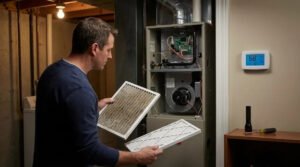
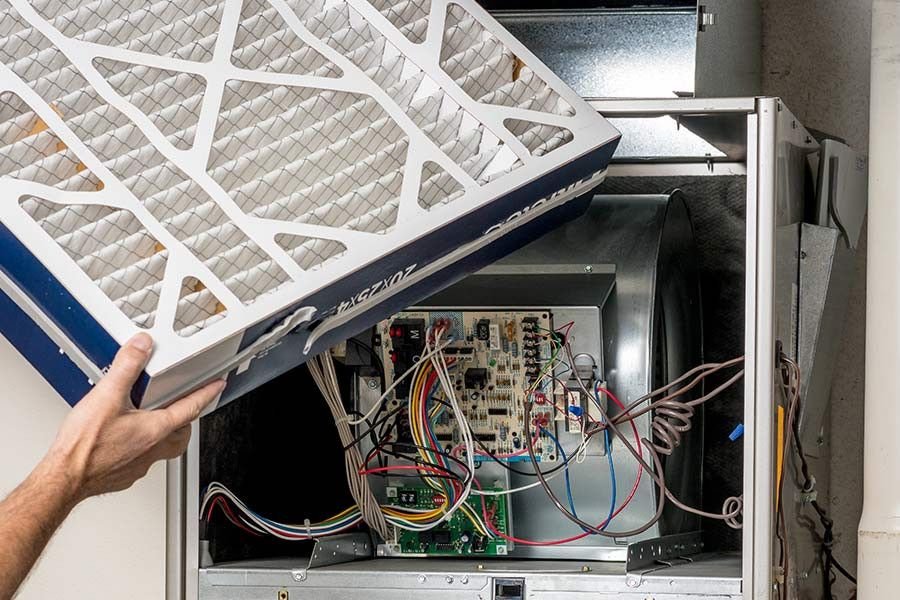
A dirty air filter restricts airflow across the heat exchanger. The heat exchanger temperature rises because there is not enough air moving across it to carry the heat into the ductwork. When the temperature exceeds the limit switch setting — typically 180°F to 200°F — the limit switch opens, cutting power to the gas valve. The burner shuts off, but the blower continues to run to cool the heat exchanger. After several minutes, the heat exchanger cools, the limit switch closes, the burner relights, and the cycle repeats.
The house never reaches the set temperature because the furnace never runs long enough in a single cycle to deliver enough BTUs. Each cycle delivers 5 to 10 minutes of heat, followed by 5 to 10 minutes of cool-down. The net heat delivered to the house is roughly half of what the furnace is capable of producing. The thermostat continues to call for heat throughout this process — it is never satisfied — but the furnace is cycling on its own limit switch, not on the thermostat. Replace the air filter. A clean filter restores full airflow, the heat exchanger stays within its design temperature range, the limit switch never opens, and the furnace runs long enough to satisfy the thermostat.
The closed-register trap: Closing supply registers in unused rooms to “save energy” increases the static pressure in the duct system, reduces total airflow across the heat exchanger, and causes exactly the same overheating and limit-switch cycling as a dirty filter. The registers in unused rooms should be open. The furnace was sized to heat the entire house with all registers open. Closing registers saves no energy and damages the furnace.
3. Leaky Ductwork: The Heat Is Going to the Attic, Not the Rooms
Ductwork in unconditioned spaces — attics, crawlspaces, garages — leaks 20% to 30% of its conditioned air on average, according to Department of Energy studies. The furnace produces 100,000 BTU of heat. Twenty to thirty percent of those BTUs never reach the registers. They leak out of unsealed duct joints into the attic or the crawlspace and are lost. The furnace runs and the gas bill arrives, but the rooms are cold because the heat that was paid for never arrived.
Duct leakage is the single most cost-effective energy improvement for most homes with ductwork outside the conditioned envelope. Sealing accessible duct joints with mastic — a brush-on paste that hardens to a flexible seal — and insulating ducts in unconditioned spaces can reduce leakage from 25% to under 5%. The materials cost $50 to $100. Professional Aeroseal duct sealing from the inside costs $1,500 to $3,000 and reduces leakage to near zero. A furnace that is struggling to heat the house on leaky ducts becomes a furnace that heats the house easily on sealed ducts, often with capacity to spare.
4. Thermostat Problems: Calibration, Location, and the Wrong Reading
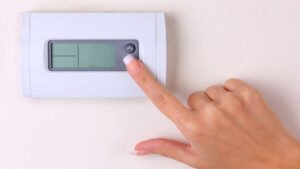
A thermostat that reads the room temperature incorrectly will stop calling for heat before the room is actually warm. Three problems cause this. First, the thermostat’s internal temperature sensor is out of calibration — it reads 72°F when the room is actually 68°F. The thermostat satisfies at its displayed 72°F, but the room is still 4°F cold. An independent thermometer placed next to the thermostat confirms the discrepancy. Some thermostats can be recalibrated through the installer settings menu. Most cannot and must be replaced ($25 to $80).
Second, the thermostat is installed in a location that does not represent the house’s average temperature. A thermostat on an interior wall near the kitchen stays warm from the oven and the refrigerator’s condenser coils while the bedrooms on the exterior walls are cold. A thermostat in a hallway with a return grille nearby is warmed by air returning from the warmer parts of the house. The fix is relocating the thermostat to a central hallway away from heat sources, or installing a thermostat with remote sensors that average the temperature across multiple rooms.
Third, the thermostat’s heat anticipator — a small adjustable resistor in older mechanical thermostats — is set incorrectly. The heat anticipator shuts off the burner slightly before the room reaches the set temperature to prevent overshooting. If the anticipator is set too high, it shuts off the burner too early. The adjustment is a small dial or lever inside the thermostat, marked in amps. Set it to match the current rating printed on the gas valve. This applies only to older mechanical thermostats, not to digital or programmable models.
5. Dirty Blower Wheel: The Fan Is Spinning but Not Moving Enough Air
The blower wheel — the squirrel-cage fan inside the furnace — accumulates a layer of household dust and lint on its blades over years of operation. A heavily fouled blower wheel can move 30% to 50% less air than a clean one at the same RPM, even though the motor is running and the fan is spinning. The airflow reduction means fewer BTUs are being transferred from the heat exchanger to the ductwork, and fewer BTUs are reaching the rooms.
A dirty blower wheel also contributes to the limit-switch cycling described in the dirty-filter section: reduced airflow causes the heat exchanger to overheat, the limit switch trips, and the furnace short-cycles. The homeowner replaces the filter, the problem persists, and the blower wheel — invisible behind the furnace panels — is the actual cause. Cleaning the blower wheel requires removing it from the furnace. A technician can do this as part of a tune-up ($100 to $200). Homeowners comfortable with disconnecting electrical connections and removing bolts can do it themselves, but the blower wheel is heavy and awkward to handle, and the furnace must be powered off at the breaker.
6. Low Gas Pressure: Not Enough Fuel to Reach Rated BTUs
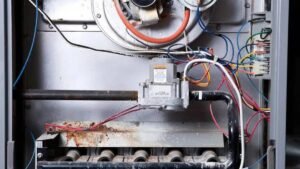
A furnace that is not producing its rated heat output may have low gas pressure at the manifold. The gas valve is adjusted at the factory or by the installer to deliver a specific manifold pressure — typically 3.5 inches of water column for natural gas — that produces the furnace’s rated BTU input. If the gas pressure is low because the gas supply line is undersized, the regulator at the meter is failing, or the gas valve itself is out of adjustment, the furnace produces fewer BTUs than its rating plate claims.
A 100,000 BTU furnace with manifold pressure at 2.5 inches of water column instead of 3.5 produces roughly 85,000 BTU — a 15% reduction in heat output. The furnace runs, the burners look normal, but the house is cold on the coldest days because the furnace is delivering less heat than the house needs. Checking and adjusting manifold gas pressure requires a manometer and should be done by an HVAC technician as part of a tune-up ($100 to $200).
7. The House Is Losing Heat Faster Than the Furnace Can Replace It
A furnace that was correctly sized when the house was built may become functionally undersized as the house ages and its thermal envelope degrades. Insulation settles and compresses, losing R-value. Weatherstripping around doors and windows compresses and cracks. Attic hatches warp and leave gaps. The cumulative effect of these small losses is a house that needs more BTUs to maintain temperature than it did when the furnace was installed.
Before replacing a furnace that appears to be undersized, air-seal the attic floor, add insulation to the attic (the single most cost-effective energy improvement for most homes), and seal air leaks around windows, doors, and penetrations. A $500 to $1,000 investment in air sealing and insulation often reduces the heating load enough that an undersized furnace becomes correctly sized. The furnace was not the problem. The house was leaking the heat the furnace produced.
FAQ: Common Questions About Furnace Not Reaching Temperature
Why does my furnace reach the set temperature during the day but not at night?
The outdoor temperature drops at night, and the house loses heat faster. A furnace that is marginally sized — just barely adequate during the day — cannot keep up when the outdoor temperature drops 10°F to 20°F at night. The furnace runs continuously but the indoor temperature slowly falls. This is a sign that the furnace is at the edge of its capacity for the house’s heat loss at the design temperature. The fix is either improving the house’s insulation and air sealing to reduce the heat loss, or replacing the furnace with a larger unit — but only after confirming the existing furnace is actually producing its rated BTUs (gas pressure check, blower wheel cleaning).
Some rooms are warm and others are cold. Is that a furnace problem?
No. Uneven heating between rooms is a duct balancing problem or a duct leakage problem, not a furnace problem. The furnace is producing the same amount of heat regardless of where it goes. The branch ducts serving the cold rooms may be undersized, kinked, disconnected, or leaking. Balancing dampers in the branch ducts can be adjusted to direct more airflow to the cold rooms. This is a $200 to $500 technician visit, not a furnace repair.
The Furnace Is Producing Heat — Find Where It Is Being Lost
A furnace that heats but never satisfies the thermostat is losing BTUs between the burner and the rooms, cycling off prematurely on a safety switch, or simply not large enough for the house on the coldest days. Replace the filter first — a $10 filter that restores normal airflow and stops limit-switch cycling is the most cost-effective repair in home heating. If the filter is clean and the furnace still short-cycles, clean the blower wheel. If the furnace runs continuously and cannot reach the set temperature, seal the ducts and air-seal the attic.
The furnace itself is the last thing to replace. The filter, the ducts, the registers, the insulation, and the air leaks are the first things to fix. Most furnaces that appear to be too small are actually the right size — the heat they produce is just not reaching the rooms, or the rooms are losing it too fast.