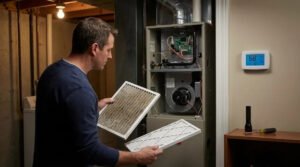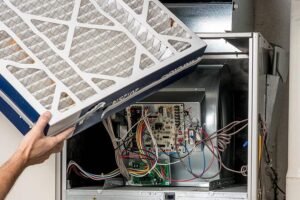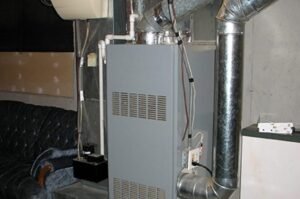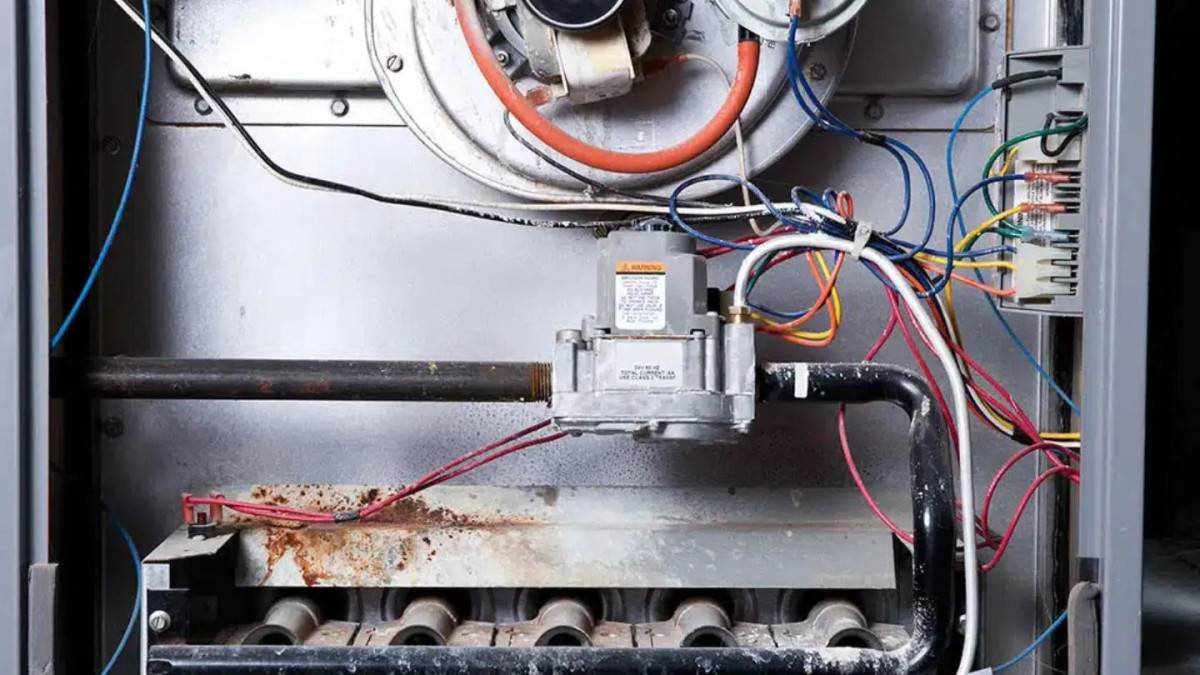
A gas furnace blowing cold air has lost its flame. The blower is running, moving air through the ductwork, but the burners are not producing heat. On a gas furnace, the flame can be lost at three points: the gas is not reaching the burners, the gas is reaching the burners but is not being ignited, or the gas is igniting but the flame is being extinguished almost immediately by a safety sensor. Each failure point has a specific set of causes, and identifying which point the furnace fails at — by watching and listening to the startup sequence — tells you exactly where the problem is.
The startup sequence on a modern gas furnace is predictable and audible. The thermostat calls for heat. The draft inducer fan starts (a low hum from the furnace). The igniter glows (visible as an orange light through the sight glass on older furnaces) or the spark igniter clicks repeatedly. The gas valve opens with an audible click. The burners light with a whoosh. The flame sensor confirms the flame is present. The blower starts 30 to 90 seconds later. Wherever this sequence stops — wherever the sound or the visible indicator is absent — is where the problem lives.
Contents
- 1 Diagnosing by the Startup Sequence: What Is Missing?
- 2 1. Gas Supply Interruption: No Fuel to Burn
- 3 2. Failed Gas Valve: The Click That Never Comes
- 4 3. Dirty Flame Sensor: Burners Light but Immediately Go Out
- 5 4. Failed Hot Surface Igniter: The Glow That Never Comes
- 6 5. Pressure Switch Not Closing: The Furnace Thinks the Flue Is Blocked
- 7 FAQ: Common Questions About Gas Furnace Cold Air
- 8 Watch the Startup Sequence to Find the Missing Step
Diagnosing by the Startup Sequence: What Is Missing?
| What Happens | What Is Missing | Most Likely Cause |
| Nothing at all — no sound | Entire startup sequence | Thermostat, power, or control board |
| Inducer fan runs, nothing else | Igniter does not glow, gas valve silent | Pressure switch, igniter, or control board |
| Igniter glows, no flame | Gas valve does not open | Gas valve, gas supply, or control board |
| Burners light, flame goes out immediately | Flame sustained | Flame sensor dirty or failing |
| Burners run, blower starts, air turns cold mid-cycle | Burners stay lit | Limit switch tripping |
1. Gas Supply Interruption: No Fuel to Burn
A gas furnace that runs its inducer fan, glows its igniter, but never produces a flame — or a furnace that was working yesterday and is suddenly dead today — may have lost its gas supply. Unlike a natural gas furnace connected to a utility line, the gas supply can be interrupted at the furnace itself: the gas valve on the supply line may have been turned off accidentally during summer maintenance and never turned back on. The valve handle — typically red or yellow — is ON when parallel to the pipe and OFF when perpendicular. Turn the handle parallel to the pipe.
If the gas valve at the furnace is ON and the furnace still does not fire, the gas supply from the utility may be interrupted. A gas meter that has been locked by the utility for non-payment, a gas line that has been damaged by construction, or a utility outage all stop gas flow to the furnace. Check other gas appliances in the house — the stove, the water heater, the dryer. If none of them have gas, the problem is at the meter or the utility line. Call the gas company. If other appliances have gas but the furnace does not, the problem is between the furnace’s internal gas valve and the supply line, and the gas valve itself may have failed.
Gas leak safety: If you smell gas — a rotten-egg odor — anywhere near the furnace or the gas line, leave the house immediately. Do not turn any lights on or off. Do not use a phone inside. Do not unplug anything. Go outside and call the gas company’s emergency line. A gas leak is not a DIY repair. The consequences of attempting one are lethal.
2. Failed Gas Valve: The Click That Never Comes
The gas valve is an electrically operated solenoid that opens when the control board sends it 24 volts. A properly functioning gas valve makes an audible click when it opens. If the inducer fan runs, the igniter glows, but there is no click and no flame, the gas valve is not opening. The valve may have a failed solenoid coil, a stuck internal diaphragm, or it may not be receiving the 24-volt signal from the control board.
A technician can test the gas valve by measuring the voltage at the valve terminals during the ignition sequence. If 24 volts is present and the valve does not open, the valve has failed and must be replaced ($500 to $1,000). If 24 volts is not present, the control board is not sending the signal, and the board may be the failed component ($400 to $800). Gas valves rarely fail without warning. A valve that is failing may produce a weak flame, a delayed ignition (a small bang when the burners finally light), or intermittent operation — sometimes the burners light, sometimes they do not — before it fails completely.
3. Dirty Flame Sensor: Burners Light but Immediately Go Out
A gas furnace where the burners light — the whoosh of ignition is audible, and you can see the blue flame through the sight glass — but the flame goes out after 3 to 8 seconds has a dirty flame sensor. The flame sensor is a thin metal rod, typically with a single wire and a porcelain insulator, positioned in the burner flame. It generates a microamp current when in contact with the flame, and that current signals the control board that the burners are lit and it is safe to keep the gas flowing. When the sensor is coated with soot or silica from combustion, it cannot generate enough current, and the control board shuts off the gas valve to prevent unburned gas from accumulating.
This is the single most common gas furnace problem that causes cold air. Cleaning the flame sensor is a 10-minute DIY job. Turn off power to the furnace. Locate the flame sensor — on the burner assembly, in front of one of the burner ports, held by a single screw. Remove the screw, pull the sensor out, and gently rub the metal rod with a dollar bill (which is abrasive enough to remove soot without scratching the surface) or fine steel wool. Do not use sandpaper — it scratches the sensor and creates grooves where carbon accumulates faster. Reinstall the sensor, restore power, and run the furnace. The flame should stay lit. A flame sensor that is clean and still cannot hold the flame may be electrically failing. Replacement costs $150 to $300.
4. Failed Hot Surface Igniter: The Glow That Never Comes
A hot surface igniter is a flat ceramic element — roughly 2 to 3 inches long, usually silicon carbide or silicon nitride — that glows orange-hot when energized. It is the ignition source on virtually every gas furnace manufactured in the last 30 years. The igniter has a finite service life of 7 to 12 years. When it fails — cracking, burning out, or developing a high-resistance spot that prevents it from reaching ignition temperature — the furnace goes through its startup sequence, the igniter either does not glow or glows weakly, the gas valve opens but the gas does not light, and the furnace locks out after three to four attempts.
A failed igniter is visible: the igniter may have a visible crack, a white powdery residue at the crack site, or a section that glows dimly while the rest glows brightly. A technician can replace a hot surface igniter in 30 to 60 minutes. The part costs $30 to $80. The total cost is $200 to $400. Homeowners should not attempt to replace an igniter themselves — the igniter is fragile and easily broken during installation, and a fragment of the broken igniter can fall into the heat exchanger and block the flue passage.
5. Pressure Switch Not Closing: The Furnace Thinks the Flue Is Blocked
Every gas furnace manufactured in the last 30 years has a pressure switch that verifies the draft inducer fan is running and the flue is clear before allowing the ignition sequence to proceed. The inducer fan creates a vacuum in the burner compartment, and the pressure switch detects that vacuum and closes, sending a signal to the control board that it is safe to ignite. If the pressure switch does not close — because the inducer fan is not running, the flue is blocked, the condensate drain is clogged on a high-efficiency furnace, or the pressure switch itself has failed — the furnace will not proceed past the inducer fan stage. The inducer runs, but nothing else happens.
Check the PVC intake and exhaust pipes on a high-efficiency furnace for blockages: snow, ice, leaves, bird nests. Check the condensate drain line for clogs — a clogged drain can back water up into the inducer housing and prevent the pressure switch from closing. If the pipes and drain are clear, the pressure switch itself may have failed. A technician can test the pressure switch with a manometer. Replacement costs $200 to $350.
FAQ: Common Questions About Gas Furnace Cold Air
My propane furnace is blowing cold air. Is the diagnosis different from natural gas?
The furnace components are identical — propane furnaces use the same gas valve, burners, igniter, and flame sensor as natural gas furnaces. The difference is the fuel supply. A propane furnace that is blowing cold air may have an empty propane tank — check the tank gauge. Propane tanks are filled by a delivery truck, not by a continuous utility line. An empty tank is the most common no-heat cause on a propane furnace. If the tank has fuel, the diagnostics for the furnace itself are the same as natural gas.
My 30-year-old gas furnace has a pilot light. Why is it blowing cold air?
The pilot light is out. Older furnaces with standing pilot lights — typically manufactured before the mid-1990s — cannot fire the burners without a pilot flame. The pilot light is a small blue flame visible through a sight glass on the front of the furnace. If it is out, relight it following the instructions on the furnace’s rating plate: turn the gas valve to OFF, wait 5 minutes, turn to PILOT, press and hold the red reset button, light the pilot with a long match, and hold the button for 30 to 60 seconds. If the pilot goes out when you release the button, the thermocouple has failed. A thermocouple costs $10 to $20. The total repair cost is $150 to $250.
Watch the Startup Sequence to Find the Missing Step
A gas furnace blowing cold air has lost its flame at one specific point in the startup sequence. The inducer fan should run. The igniter should glow. The gas valve should click. The burners should light. The flame sensor should hold the flame. The blower should start. Wherever the sequence stops is where the problem lives — and each step has a specific fix.
The dirty flame sensor is the most common cause and the easiest fix: a 10-minute cleaning with a dollar bill. The blocked pressure switch is the second most common: check the intake and exhaust pipes and the condensate drain. The gas supply interruption — the valve turned off at the furnace — is the simplest fix and the most overlooked. Start with the gas valve handle. Check the filter. Listen to the startup sequence. The furnace tells you what is wrong before you ever open a panel.