A furnace that runs but does not produce heat is failing at one of three stages: the call for heat never reaches the furnace, the burner never lights, or the burner lights but the heat never reaches the rooms. Each stage has a specific set of causes, and identifying which stage the failure occurs at narrows the diagnosis from dozens of possibilities to two or three. The sequence is predictable: the thermostat calls, the draft inducer fan starts, the igniter glows or the pilot lights, the gas valve opens, the burner fires, the flame sensor confirms ignition, and the blower distributes the heated air. The point in that sequence where the process stops tells you exactly what failed.
Before calling a technician, five zero-cost checks solve roughly half of furnace no-heat calls: verify the thermostat settings and batteries, confirm the furnace power switch is on, check that the gas valve at the furnace is open, replace a clogged air filter, and inspect the circuit breaker. If the furnace is still not heating after those five checks, work through the remaining causes in order, starting with the most common and working toward the least common. The flame sensor, the limit switch, and the condensate drain account for most of the remaining failures.
Maintaining a consistent indoor temperature requires more than just a functioning thermostat; it demands that every mechanical component operates in harmony. While basic troubleshooting can often resolve minor issues like dead batteries or tripped breakers, persistent failures in heat production may stem from deep-seated electrical faults or fuel line obstructions. Homeowners in coastal regions often face unique environmental challenges, such as salt air corrosion, which necessitates specialized knowledge from hvac sarasota professionals to ensure system longevity. Addressing these hidden stressors through preventative care prevents the sudden inconvenience of a cold home during unexpected temperature drops. By staying proactive with routine inspections, you can identify worn ignitors or cracked heat exchangers before they lead to total system failure.
Contents
- 1 1. Thermostat: The Most Common Simple Fix
- 2 2. Power and Gas Supply: The Basics That Get Overlooked
- 3 3. Dirty Air Filter: Airflow Restriction Triggers the Safety Shutdown
- 4 4. Pilot Light and Ignition Problems
- 5 5. Dirty Flame Sensor: The Burner Lights, Then Shuts Off Immediately
- 6 6. Condensate Drain Clog: High-Efficiency Furnace Shutdown
- 7 7. Blocked Intake or Exhaust Vent: The Outdoor Problem
- 8 8. Blower Motor Failure: The Burner Works, But No Warm Air
- 9 9. Control Board Error Codes: What the Blinking Light Means
- 10 FAQ: Common Questions About Furnace No-Heat Problems
- 11 Troubleshoot in Order: Thermostat, Filter, Flame Sensor, Then Call
1. Thermostat: The Most Common Simple Fix
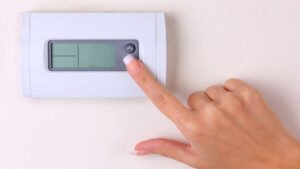
A furnace that does nothing when the temperature is turned up has either lost its connection to the thermostat or has a thermostat that is not calling for heat. The thermostat is the single most common cause of a no-heat service call, and it is also the easiest to fix.
Check three things on the thermostat before opening the furnace.
First, verify the thermostat is set to HEAT, not COOL or OFF. A thermostat accidentally bumped to COOL during shoulder-season cleaning accounts for a surprising number of service calls.
Second, set the temperature at least 5°F above the current room temperature. If the thermostat display is blank or dim, replace the batteries. A thermostat with dead batteries cannot close the relay that sends the 24-volt signal to the furnace control board.
Third, if the thermostat is a programmable model, check that the program is not overriding the manual temperature setting. Some programmable thermostats have a HOLD button that must be pressed to maintain a manual setting past the next programmed change.
If the thermostat is battery-powered and the batteries are fresh, remove the thermostat from its wall plate and use a small piece of wire to briefly jump the R (power) and W (heat) terminals on the wall plate. If the furnace starts, the thermostat is faulty. If the furnace does not start, the problem is in the furnace or the wiring between the thermostat and the furnace. A basic non-programmable thermostat costs $25 to $50 and takes 15 minutes to replace.
2. Power and Gas Supply: The Basics That Get Overlooked
A furnace needs electricity and gas. If either is interrupted, the furnace cannot produce heat regardless of what the thermostat is telling it to do.
Every furnace has a power switch on or near the unit: a light-switch-style toggle on a metal box mounted on the side of the furnace or on the wall nearby.
This switch looks exactly like a light switch, and it gets turned off accidentally more often than any HVAC technician wants to admit. If the switch is off, the furnace has no power. Turn it on and wait 30 seconds for the control board to boot.
Also check the circuit breaker in the main electrical panel. A furnace on a dedicated circuit will have a labeled breaker. Reset it by flipping it fully to OFF, then back to ON. If the breaker trips again immediately, there is a short circuit in the furnace wiring: call a technician.
The gas supply to the furnace is controlled by a valve on the gas line, typically a red or yellow lever handle located on the pipe running into the furnace. The valve is ON when the handle is parallel to the pipe and OFF when the handle is perpendicular. If the valve was turned off during summer maintenance and never turned back on, the furnace will go through its entire startup sequence, the igniter will glow, and nothing will happen — because there is no gas to burn. Turn the handle parallel to the pipe. If you smell gas at any point during this process, leave the house immediately and call the gas company from outside.
3. Dirty Air Filter: Airflow Restriction Triggers the Safety Shutdown
A furnace that starts, runs for a few minutes, and shuts off before the house reaches the set temperature is overheating. The most common cause is a dirty air filter.
When the filter is clogged, airflow across the heat exchanger drops. The heat exchanger temperature rises because there is not enough air moving across it to carry the heat away.
When the temperature exceeds the limit switch setting (typically 180°F to 200°F), the limit switch opens, cutting power to the gas valve. The burner shuts off. The blower continues to run to cool the heat exchanger.
When the temperature drops below the reset threshold, the limit switch closes and the burner relights. The furnace cycles between heating and overheating until the filter is changed or the limit switch fails permanently open.
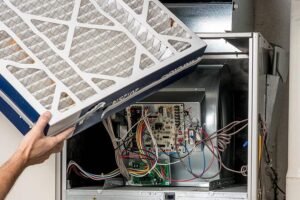
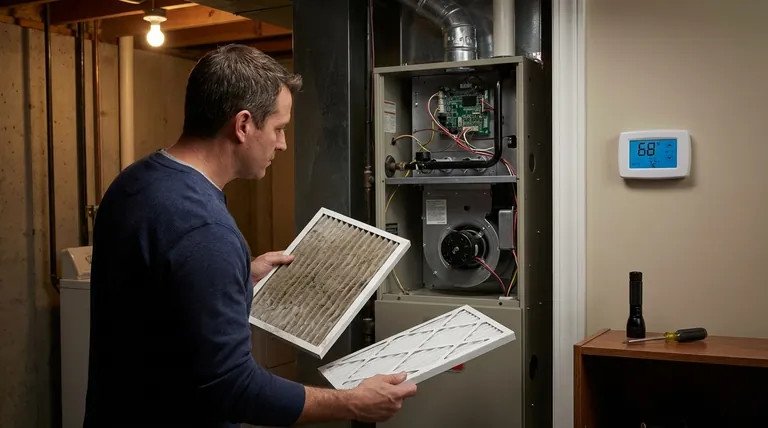
Replace a standard 1-inch disposable furnace filter every 30 to 90 days depending on usage and household conditions (pets, dust, construction). A 4-inch media filter lasts 6 to 12 months. A washable electrostatic filter should be rinsed monthly during heating season. The filter is located in the return air duct near the furnace — either in a slot in the side of the furnace cabinet or in a filter grille in the wall or ceiling. The airflow arrow printed on the filter frame must point toward the furnace.
Limit switch reset: If the limit switch has tripped and the furnace will not restart after the filter is changed and the furnace has cooled for 30 minutes, the limit switch may have failed permanently open. Some limit switches have a manual reset button — a small red button on the switch housing inside the furnace burner compartment. Press it firmly. If the furnace restarts, the limit switch was manually tripped and is now reset. If it trips again within minutes, the overheating problem has not been solved, and the filter may not be the only airflow restriction.
4. Pilot Light and Ignition Problems
Gas furnaces light the burner in one of three ways: a standing pilot light (older furnaces, pre-1990s), an intermittent pilot with spark ignition, or a hot surface igniter (most furnaces manufactured in the last 25 years). The symptom for each is different.
A standing pilot light that has gone out is visible through a small window on the front of the furnace. If there is no blue flame visible when the furnace is idle, the pilot is out. Relight it by following the instructions printed on the furnace’s rating plate: turn the gas valve to OFF, wait 5 minutes for unburned gas to dissipate, turn the valve to PILOT, press and hold the red reset button while lighting the pilot with a long match or barbecue lighter, and continue holding the button for 30 to 60 seconds after the pilot lights to allow the thermocouple to heat up. Release the button. If the pilot stays lit, turn the valve to ON. If the pilot goes out when you release the button, the thermocouple — a small metal probe that sits in the pilot flame and generates a tiny electric current to hold the gas valve open — has failed. A thermocouple costs $10 to $20 and takes a technician 30 minutes to replace.
A hot surface igniter failure is the most common ignition problem on modern furnaces. The igniter is a flat ceramic element, roughly 2 to 3 inches long, that glows orange-hot when energized. When the thermostat calls for heat, the draft inducer fan starts, the igniter glows, the gas valve opens, and the burner lights. If the igniter is cracked, burned out, or covered in soot, it will not reach the temperature needed to ignite the gas. The furnace will attempt ignition three to four times, then lock out and display an error code. A hot surface igniter costs $30 to $80 for the part and $200 to $400 installed by a technician. It is a common wear item that typically fails after 7 to 12 years.
5. Dirty Flame Sensor: The Burner Lights, Then Shuts Off Immediately
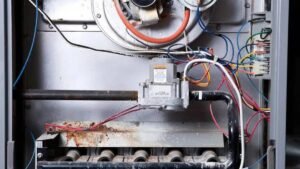
A furnace that lights the burner successfully, the flame burns for 3 to 8 seconds, and then the gas valve shuts off is experiencing a flame sensor failure. The flame sensor is a thin metal rod — usually a single wire with a porcelain insulator — positioned in the burner flame path. It generates a microamp electrical current when it is in contact with the flame, and that current tells the control board that the burner is lit and it is safe to keep the gas valve open. If the sensor is coated with soot, silica, or carbon deposits, it cannot detect the flame. The control board interprets the absence of a flame signal as a failed ignition and shuts the gas valve to prevent unburned gas from accumulating in the combustion chamber.
Cleaning the flame sensor is a 10-minute job that requires nothing more than a screwdriver and a dollar bill or a piece of fine steel wool. Turn off power to the furnace at the service switch. Locate the flame sensor — it is mounted on the burner assembly with a single screw, directly in front of one of the burner ports. Remove the screw, pull the sensor out, and gently rub the metal rod with a dollar bill (which is abrasive enough to remove soot but not abrasive enough to scratch the sensor surface) or fine steel wool. Do not use sandpaper — it scratches the sensor surface and creates grooves where carbon will accumulate faster. Reinstall the sensor, restore power, and start the furnace. The flame should stay lit. A flame sensor that is clean and still cannot hold the flame open may be cracked or electrically failing, and replacement costs $150 to $300.
6. Condensate Drain Clog: High-Efficiency Furnace Shutdown
A condensing furnace with 90%+ AFUE produces acidic water as a byproduct of the secondary heat exchanger. That condensate drains through a PVC pipe to a floor drain, a condensate pump, or outside. When the drain line clogs with algae, sediment, or debris, water backs up inside the furnace. A pressure switch detects the blockage and prevents the furnace from starting — or shuts it down mid-cycle — to prevent water from flooding the burner compartment.
Check the condensate drain line first: the PVC pipe exiting the side or bottom of the furnace should be clear and unobstructed. If the furnace has a condensate pump (a small plastic box on the floor next to the furnace with a vinyl tube running to a drain), verify the pump is receiving power and the float inside the reservoir moves freely. Pour a cup of water into the pump reservoir to test it — the pump should activate and pump the water out. If it does not, the pump has failed and needs replacement ($60 to $150 for the pump, plus labor). Clean the drain line by pouring a cup of warm water mixed with a few drops of bleach into the drain trap (accessible inside the furnace cabinet) to kill algae and flush sediment.
7. Blocked Intake or Exhaust Vent: The Outdoor Problem
High-efficiency furnaces use two PVC pipes that exit through an exterior wall or the roof: one for combustion air intake and one for exhaust. If either pipe is blocked — by snow, ice, a bird’s nest, leaves, or a plastic bag — the pressure switch inside the furnace will not close, and the furnace will not start. The draft inducer fan will run, the furnace will attempt to start, and nothing will happen.
Go outside and find the two PVC pipes exiting the house near ground level or through the roof. Check for snow accumulation in front of the pipe openings — this is the most common cause of a no-heat call on a winter morning after a heavy snowstorm. Clear snow away from the pipes. Check for ice forming inside the pipe opening from condensation freezing at the rim. Check for bird nests, rodent nests, or debris inside the pipes — use a flashlight to look as far into the pipe as you can see. The intake and exhaust pipes should have a clear, unobstructed path from the furnace to the outdoors. If one pipe is blocked, the furnace will not run.
8. Blower Motor Failure: The Burner Works, But No Warm Air
A furnace that fires the burner — you hear the whoosh of the flame and feel heat radiating from the furnace cabinet — but produces no warm air from the registers has a blower motor failure. The blower is the large fan inside the furnace that pulls return air across the heat exchanger and pushes heated air into the ductwork. If the blower does not run, the heat exchanger temperature rises until the limit switch trips, and the burner shuts off. The furnace cycles on the limit switch: burner fires, heat exchanger overheats, limit switch trips, blower never starts, furnace cools, limit resets, cycle repeats.
A failing blower motor typically gives warning before it stops completely. A humming sound from the furnace that never progresses to the blower starting is a failed start capacitor — a $15 to $30 part that takes a technician 20 minutes to replace. A squealing or grinding sound from the blower compartment is a failing blower motor bearing. A blower that starts slowly, runs for a few minutes, and stops is a motor overheating from worn bearings or a failing winding. Blower motor replacement costs $400 to $1,200 depending on whether the furnace uses a standard PSC motor or an ECM variable-speed motor.
9. Control Board Error Codes: What the Blinking Light Means
Every modern furnace has a control board with an LED that blinks in a specific pattern to indicate the fault that is preventing the furnace from starting. The LED is visible through a small window on the lower front panel of the furnace. The blink pattern and its meaning are printed on the inside of the panel or in the furnace’s installation manual.
| LED Pattern | Typical Meaning | DIY Fix? |
| Steady ON | Normal operation, no call for heat | Check thermostat |
| Steady OFF | No power to furnace | Check power switch and breaker |
| 1 blink | Ignition failure or lockout | Clean flame sensor or check gas supply |
| 2 blinks | Pressure switch stuck open | Check intake/exhaust for blockage, check condensate drain |
| 3 blinks | Pressure switch stuck closed | Check pressure switch tubing for water or kinks |
| 4 blinks | Limit switch open (overheating) | Replace filter, check all supply registers are open |
| Rapid flashing | Polarity reversed or grounding issue | No — call electrician |
Count the blinks carefully. The pattern repeats with a pause between cycles. Write down the number of blinks before doing anything else. If the furnace has an error code history (some Carrier, Trane, and Lennox boards store the last several fault codes), retrieve those codes as well by following the procedure on the panel label. The error code tells the technician which sensor triggered the shutdown, which cuts diagnostic time significantly.
FAQ: Common Questions About Furnace No-Heat Problems
I smell gas near the furnace. What should I do?
Leave the house immediately. Do not turn any lights on or off. Do not use a phone inside the house. Do not unplug anything. Go outside and call the gas company’s emergency line from a safe distance. A gas leak is not a DIY repair, and the consequences of attempting one are lethal. The gas company will send a technician at no charge to locate and shut off the leak.
Why does my furnace keep turning on and off without heating the house?
Short cycling — the burner fires for 2 to 5 minutes, shuts off, and restarts a few minutes later — is caused by overheating from restricted airflow (dirty filter, closed registers, blocked return), a failed limit switch, or an oversized furnace. An oversized furnace heats the air so fast that the temperature rise across the heat exchanger exceeds the limit switch setting, and the furnace shuts down on safety before the thermostat is satisfied. The fix for an oversized furnace is replacement with a correctly sized unit, not a repair.
Troubleshoot in Order: Thermostat, Filter, Flame Sensor, Then Call
A furnace that does not heat has failed at one of nine points in its operating sequence. The thermostat call, the power and gas supply, the airflow, the ignition, the flame detection, the condensate drain, the intake and exhaust vents, the blower motor, or the control board. Each point has a specific set of symptoms that identifies it as the failure point.
Start at the thermostat — dead batteries are the most common no-heat cause overall. Replace the filter — a clogged filter is the most common cause of a furnace that starts but does not stay running. Clean the flame sensor — a dirty sensor is the most common cause of a furnace that lights and immediately goes out. If none of those three fixes restores heat, count the blinks on the control board LED and call a technician with the code in hand. The error code tells them where to start looking, and that information saves an hour of diagnostic labor.