Solar panels are warrantied for 25 to 30 years to produce at least 80 to 92 percent of their original rated output by the end of the warranty period. In practice, most panels continue producing useful electricity for 30 to 40 years or longer. Panels installed in the 1980s are still generating power today at 70 to 80 percent of their original output. Solar panels do not suddenly fail at year 25. They degrade slowly, predictably, and almost never catastrophically.
The limiting factor for system lifespan is usually not the panels. It is the inverter, the roof underneath the panels, or the homeowner’s patience with gradually declining output. Here is how panels age, what affects their lifespan, and what to expect at each stage of their life.
Contents
The Warranty: What It Actually Guarantees
Every solar panel sold in the United States carries two warranties. The product warranty covers manufacturing defects, delamination, and premature failure. The performance warranty guarantees a minimum power output at specific milestones over the warranty period.
A standard performance warranty guarantees 90 to 98 percent of original output at year 1, reflecting an initial drop as the panels settle into operation, and 80 to 87 percent at year 25, with a maximum annual degradation rate of 0.5 to 0.7 percent. Premium panels from SunPower, REC, and Panasonic warrant 92 percent output at year 25 with annual degradation capped at 0.25 to 0.35 percent. The product warranty on most panels is 25 years. Premium panels often carry 25 to 30 years.
The warranty is a floor, not a ceiling. Panels typically degrade slower than the warranty maximum. The National Renewable Energy Laboratory found that modern monocrystalline panels degrade at a median rate of approximately 0.5 percent per year in real-world conditions. At that rate, a panel produces approximately 88 percent of its original output at year 25, comfortably above the 80 percent warranty floor for standard panels.
| Panel Type | 25-Year Output | Annual Degradation | Example Brands |
| Standard monocrystalline PERC | 80–85% | 0.5–0.7% | Qcells, Canadian Solar, Trina |
| Premium monocrystalline | 87–90% | 0.3–0.5% | REC Alpha, Panasonic EverVolt |
| Premium back-contact | 92% | 0.25% | SunPower Maxeon |
| Thin-film (CdTe/CIGS) | 80–85% | 0.5–1.0% | First Solar, MiaSolé |
Why Panels Degrade and What Slows It Down
Solar panel degradation is driven by three mechanisms. Light-induced degradation occurs in the first hours of operation when boron and oxygen in the silicon cells react under sunlight, causing a permanent drop of 1 to 3 percent. This initial loss is factored into the warranty, which allows a higher first-year drop before the annual cap begins.
Potential-induced degradation occurs when voltage potential between the cells and the grounded frame causes current leakage that degrades cell performance over years. Modern panels include anti-PID technology that has largely mitigated this mechanism.
Thermal cycling and UV exposure degrade the encapsulation materials over decades. The ethylene vinyl acetate, or EVA, layer that encapsulates the cells slowly yellows under UV, reducing light transmission. The polymer back sheet can crack and delaminate from repeated heating and cooling cycles. These are the degradation mechanisms that determine the panel’s end of life, not the silicon cells themselves. The cells could generate power for 50 years or more. The packaging fails first.
Climate affects degradation rate meaningfully. Panels in hot desert climates degrade faster because heat accelerates chemical degradation of the encapsulant. Panels in moderate coastal climates degrade slower. Panels in cold climates with snow and freeze-thaw cycles are subject to mechanical stress on the frame and glass. Panels in humid climates with salt spray face corrosion of the cell connections and frame. No climate is ideal. Each climate stresses panels differently.
What Happens After the Warranty Expires
Nothing dramatic. The panels continue producing electricity. You lose warranty coverage for output guarantees and manufacturing defects, but the panels themselves keep working. The output continues to decline at roughly the same rate. A panel producing 85 percent of original output at year 25 produces approximately 80 percent at year 30 and 75 percent at year 35.
The decision to replace panels is economic, not technical. Panels do not need to be replaced at year 25. They need to be replaced when the value of the electricity they produce no longer justifies the roof space they occupy. For a homeowner who installed panels at $3.00 per watt and paid off the system in year 10, the panels at year 25 are producing free electricity at 85 percent of their original output. There is no financial reason to replace them. For a homeowner who wants to maximize rooftop generation for a new electric vehicle or heat pump, replacing 25-year-old panels with modern panels that are 40 percent more efficient per square foot may be worthwhile even though the old panels still work.
The Inverter Dies First
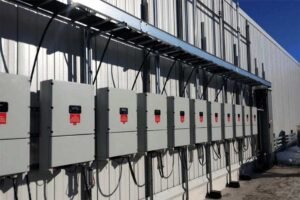
The inverter is the component that converts DC electricity from the panels into AC electricity for your home. It contains capacitors, circuit boards, and cooling fans that wear out on a 10 to 15 year timeline. A string inverter typically needs replacement once during the panel warranty period at a cost of $1,500 to $2,500. Microinverters from Enphase carry a 25-year warranty and typically last the full panel life, though individual units can fail and are replaced individually at a cost of $150 to $250 each.
The inverter replacement is a planned expense. It is not a surprise failure. The monitoring system typically provides weeks or months of warning through declining performance before a complete failure. Budget for one inverter replacement during the panel warranty period and potentially a second if you keep the panels beyond 30 years.
Real-World Lifespan Data
The oldest grid-connected solar installations provide empirical lifespan data. The University of Oldenburg in Germany has monitored panels installed in 1976 that still produce 75 to 80 percent of their original output after nearly 50 years. The Solar Energy Centre in Denmark documented panels from the 1980s producing at 70 to 80 percent after 35 years. The National Renewable Energy Laboratory in Colorado has long-term test data on thousands of panels showing consistent slow degradation with few catastrophic failures.
The common failure modes in aging panels are not the cells. They are delamination of the EVA encapsulant, corrosion of the solder bonds connecting the cells, hot spots from localized shading or cell defects that burn through the back sheet over years, and bypass diode failure in the junction box, which is a $50 to $100 repair that a technician can perform on the roof. These failures reduce output gradually and are repairable. They do not require panel replacement.
Recycling and Disposal at End of Life
Solar panels are recyclable. The aluminum frame, glass, copper wiring, and silicon cells can all be recovered. The challenge is not the technology. It is the economics. Recycling a solar panel costs $20 to $30 per panel. The recovered materials are worth $3 to $5. The gap is currently filled by landfill disposal because it is cheaper. As the volume of decommissioned panels grows in the 2030s and 2040s, recycling infrastructure and regulation are expected to improve.
In the European Union, solar panel recycling is mandatory under the Waste Electrical and Electronic Equipment Directive. In the United States, solar panel recycling is regulated at the state level. Washington and California have solar panel recycling requirements. Most other states do not. If recycling is important to you, ask your installer whether they have a take-back or recycling program for panels at end of life.
How to Maximize Panel Lifespan
Keep panels clean. Dust, pollen, bird droppings, and salt spray reduce output and can cause hot spots that damage cells over time. In most climates, rain cleans panels adequately. In dry dusty climates and coastal areas, annual professional cleaning extends panel life and maintains output.
Monitor system performance. A sudden drop in output indicates a problem that can be fixed before it causes permanent damage. A single failed bypass diode or a cracked cell can be repaired if caught early. Ignored, it can degrade into a hot spot that damages the back sheet and requires panel replacement.
Trim overhanging branches. A branch that grows to shade a panel reduces output from that panel and the entire string if a string inverter is used without optimizers. Falling branches are the most common cause of catastrophic panel damage from impact.
Maintain the inverter. String inverters have cooling fans that accumulate dust. An annual visual inspection of the inverter for dust buildup and proper ventilation prevents overheating and extends inverter life. Most homeowners never look at their inverter after installation. A two-minute visual check once a year identifies problems before they become failures.
Frequently Asked Questions
When should I replace my solar panels?
Not at year 25 just because the warranty expired. Replace them when output has declined to the point that the roof space is more valuable for new, more efficient panels than for keeping the old ones. For most homeowners, this point arrives at 30 to 40 years. If you are adding a major new electric load like an EV or heat pump and need more generation than your old panels and available roof space can provide, replacing old panels with modern higher-efficiency panels may be the right decision even if the old panels still function.
What happens to leased panels at end of life?
The lease agreement specifies removal and disposal responsibility. Most solar leases require the leasing company to remove the panels at the end of the lease term or at the end of the panel’s useful life, at the company’s expense. If the lease term ends before the panels stop working, the lease may offer you the option to purchase the panels at a depreciated price, extend the lease, or have them removed. Read the lease agreement before signing. The end-of-life terms vary significantly between companies.
Are new panels today meaningfully better than panels from 10 years ago?
Yes, but the improvement is incremental, not revolutionary. A standard residential panel in 2015 was 250 to 300 watts and 16 to 18 percent efficient. A standard panel today is 400 to 450 watts and 20 to 22 percent efficient. The wattage increase is driven partly by higher efficiency and partly by physically larger panels. The practical benefit for a homeowner is that you can generate more power from the same roof area. If you have unlimited roof space, the efficiency improvement does not matter. If roof space is limited, today’s panels generate more electricity per square foot, which is valuable.