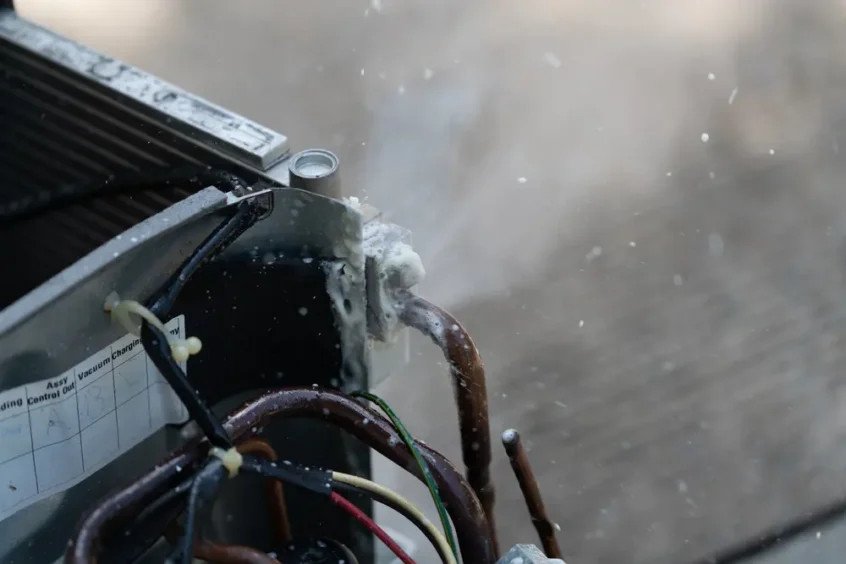
The “AC pipe” that freezes is the suction line — the larger of the two copper pipes running between the outdoor condenser and the indoor evaporator coil, typically wrapped in black foam insulation. Ice on this pipe means the refrigerant inside it is returning to the compressor at a temperature below freezing. The ice did not start on the pipe. It started on the evaporator coil inside the air handler. The coil temperature dropped below 32°F, condensation on the coil froze, the ice layer grew, and the cold refrigerant carried that sub-freezing temperature through the suction line back toward the outdoor unit. The ice on the pipe outside is the visible evidence of a frozen coil inside.
A frozen AC is not cooling the house — the ice layer on the evaporator coil blocks airflow and insulates the coil from the warm return air, so the refrigerant cannot absorb heat from the house. The compressor continues to run, pulling the coil temperature lower, thickening the ice, and compounding the problem. The unit must be shut off, the ice must be allowed to thaw completely, and the root cause — almost always inadequate airflow or low refrigerant — must be fixed before the unit is restarted. Restarting a frozen AC without fixing the cause guarantees the ice returns, and each freeze-thaw cycle stresses the compressor.
When ice starts to coat your outdoor unit or indoor evaporator coils, it is often a symptom of a deeper mechanical imbalance within the refrigeration cycle. Beyond simple maintenance oversights like dirty filters, more complex issues such as restricted metering devices or damaged fan blades can drastically reduce thermal exchange. Homeowners in areas like Laurel frequently encounter these technical glitches during peak summer humidity, where even a slight drop in system pressure causes condensation to flash-freeze instantly. Addressing these systemic failures early prevents the compressor from overheating or suffering liquid slugging, which can lead to catastrophic motor failure and an entirely preventable system replacement during the hottest months of the year.
Contents
- 1 1. Low Refrigerant: The Most Common Cause (60%+ of Frozen AC Pipes)
- 2 2. Restricted Airflow: Dirty Filter, Dirty Coil, or Blocked Returns
- 3 3. Failing Blower Motor or Blower Set Too Low
- 4 4. Running the AC When It Is Too Cold Outside
- 5 5. Oversized AC Unit: Short Cycles, Frozen Coils
- 6 How to Thaw a Frozen AC Pipe and Restart Safely
- 7 FAQ: Common Questions About Frozen AC Pipes
- 8 A Frozen AC Pipe Is a Warning That the System Is Damaging Itself
1. Low Refrigerant: The Most Common Cause (60%+ of Frozen AC Pipes)
Low refrigerant is the leading cause of a frozen suction line. When the system’s refrigerant charge drops — because of a slow leak at a brazed joint, a Schrader valve, or the evaporator coil itself — the pressure inside the evaporator coil drops as well. Lower pressure means a lower boiling point. The refrigerant that should be evaporating at 40°F is now boiling at 25°F. The coil temperature drops below freezing. Condensation on the coil turns to ice. The ice layer grows outward from the coil, into the condensate pan, and eventually down the suction line.
A system that is low on refrigerant will typically show a pattern: the unit cools adequately for the first 20 to 30 minutes, then the cooling output drops, and frost or ice appears on the suction line at the outdoor unit. The initial cooling is normal because the refrigerant charge is just barely adequate when the system first starts. As the system runs, the coil temperature falls and the ice begins to form. The ice insulates the coil, reducing heat absorption, which lowers the suction pressure further, which drops the coil temperature further — a feedback loop that ends with a solid block of ice around the coil.
The two-pipe identification: The suction line is the larger pipe, wrapped in black foam insulation. It carries cold refrigerant gas from the indoor coil back to the compressor. It should feel cold and sweaty in normal operation, not frozen. The liquid line is the smaller pipe, bare copper. It carries warm liquid refrigerant from the outdoor condenser to the indoor coil. It should feel warm to the touch. If the suction line is frozen and the liquid line is also cold, the system is severely low on refrigerant.
2. Restricted Airflow: Dirty Filter, Dirty Coil, or Blocked Returns
The evaporator coil depends on a steady flow of warm return air to keep its temperature above freezing. When airflow drops — because the filter is clogged with dust, the evaporator coil itself is matted with pet hair and lint, or the return vents are blocked by furniture — the coil has less warm air to absorb heat from. The refrigerant inside the coil gets colder and colder until it drops below freezing. The airflow restriction does not have to be severe: a filter that looks “not that dirty” can reduce airflow by 20% to 30%, which is enough to drop the coil temperature below 32°F on a mild day when the system runs for long cycles.
Check the air filter first. Replace it if it has been more than 30 days since the last change. Inspect the evaporator coil by opening the access panel on the air handler or furnace. If the coil face is covered with a mat of dust, pet hair, and lint, the airflow across the coil is severely restricted. A dirty coil cannot be cleaned by replacing the filter — it must be cleaned directly with a coil cleaner spray ($10 to $20) and a soft brush, or by a technician with a pump sprayer and professional coil cleaning chemicals.
Walk through the house and verify that every return grille is unobstructed. A couch pushed against a return grille, a rug draped over a floor return, or a closed door to a room with a return duct all starve the air handler of airflow. The blower can only move the air that reaches it, and a blocked return is a blocked airway for the entire system.
3. Failing Blower Motor or Blower Set Too Low
The blower motor is what moves air across the evaporator coil. If the blower is failing — running at reduced speed, starting intermittently, or not starting at all — the airflow across the coil drops to zero or near zero, and the coil freezes within minutes. A failing ECM blower motor may run at a reduced speed that still produces some airflow but not enough to keep the coil above freezing. The homeowner notices weak airflow from the registers and a frozen suction line at the outdoor unit.
On some furnaces and air handlers, the blower speed is set with DIP switches or jumpers on the control board. If the blower speed was set too low during installation — for example, the cooling speed tap was connected to the lowest speed instead of the medium or high speed — the coil will freeze on hot days when the system runs for extended periods. The fix is moving the cooling speed wire to a higher speed tap on the control board, which takes a technician 10 minutes.
4. Running the AC When It Is Too Cold Outside
Air conditioners are designed to operate within a specific outdoor temperature range (typically 60°F to 115°F for residential units). When the outdoor temperature drops below roughly 60°F, the condenser coil is too efficient at rejecting heat.
The refrigerant entering the evaporator coil is already so cold that the coil temperature drops below freezing, even with normal airflow across the coil. Running an AC on a 50°F spring evening to “take the edge off” produces a frozen coil and a frozen suction line.
If you need cooling when the outdoor temperature is below 60°F — common in server rooms, wine cellars, and commercial kitchens year-round — the outdoor unit must be equipped with a low-ambient kit (a condenser fan speed control or a head pressure control valve) that reduces the condenser’s heat rejection capacity to match the lower outdoor temperature. A low-ambient kit costs $300 to $600 installed.
Without it, do not run the AC when the outdoor temperature is below 60°F.
5. Oversized AC Unit: Short Cycles, Frozen Coils
An air conditioner that is too large for the space it serves cools the room so quickly that the thermostat satisfies before the coil temperature has stabilized at a steady operating point. The system runs for 5 to 10 minutes, shuts off, and the ice that began forming during the short cycle never gets a chance to melt.
Over multiple short cycles, the ice accumulates layer by layer until the coil is a solid block and the suction line is frozen at the outdoor unit.
An oversized AC also does a poor job of dehumidifying. The short runtime does not allow enough condensate to form on the coil to remove humidity from the air, so the house feels cold and clammy rather than cool and dry.
The homeowner often responds by setting the thermostat lower, which makes the short cycling worse, which makes the ice accumulation faster. The fix for an oversized AC is not a repair. It is replacement with a correctly sized unit.
How to Thaw a Frozen AC Pipe and Restart Safely
- Turn the thermostat to OFF and the fan to ON. This stops the compressor but keeps the blower running. The warm return air flowing across the frozen coil — without the compressor making it colder — is the fastest way to thaw the ice. Thawing takes 1 to 4 hours depending on the ice thickness.
- Do not chip at the ice. A screwdriver or an ice pick will puncture the coil or the suction line. A punctured evaporator coil is a $600 to $1,200 repair. A punctured suction line releases the entire refrigerant charge and requires a $400 to $1,500 leak repair and recharge. Wait for the ice to melt on its own.
- Place towels under the air handler. The melting ice will produce more water than the condensate drain pan is designed to hold in a short period. Towels prevent water damage to the floor or the ceiling below an attic air handler.
- Check the condensate drain before restarting. The flood of meltwater can overwhelm a partially clogged drain and trip the float switch. Pour a cup of water into the drain pan after the ice has melted and verify it drains freely. If it pools, clear the drain with a wet-dry vacuum before restarting the AC.
- Fix the root cause before restarting. If the filter was dirty, replace it. If the coil was dirty, clean it. If the refrigerant was low — indicated by the suction line freezing again within days of the thaw — call a technician. Restarting the AC without fixing the cause guarantees the ice returns.
FAQ: Common Questions About Frozen AC Pipes
Why is the pipe frozen at the outdoor unit but the indoor unit seems fine?
The ice on the suction line at the outdoor unit is the tail end of an ice layer that started on the evaporator coil inside. The coil inside the air handler or furnace is the source of the ice. The pipe outside is the visible end of it. If the suction line at the outdoor unit is frozen, the coil inside is frozen too — you just cannot see it without opening the air handler access panel. The fix is the same regardless of where you first noticed the ice: shut the system off, thaw it completely, and address the root cause.
Why is my mini-split AC pipe freezing up?
A mini-split line set that freezes has the same causes as a central AC: low refrigerant from a slow leak at a flare fitting (the most common mini-split leak point), a dirty indoor unit filter, a dirty indoor coil, or the unit running in cooling mode when the outdoor temperature is below 60°F. Mini-split flare fittings are the most common refrigerant leak point in residential HVAC because the copper flare must be perfectly formed and torqued to specification, and an installer who rushes this step creates a leak that takes months or years to become obvious — usually appearing as a frozen line set on the first hot day of the season.
A Frozen AC Pipe Is a Warning That the System Is Damaging Itself
Ice on the suction line means liquid refrigerant is returning to the compressor — a condition called slugging or liquid floodback — and liquid refrigerant destroys a compressor designed to pump gas. Every minute the AC runs with a frozen suction line is a minute the compressor is being damaged. The ice on the pipe is the visible warning. The compressor damage is the invisible consequence.
Turn the system off. Thaw it completely — this takes hours, not minutes. Replace the filter, clean the coil, and open any blocked returns. If the ice returns within days, the refrigerant charge is low, and the system has a leak that requires an EPA-certified technician to find and repair. Do not restart the AC hoping the ice was a one-time event. The ice is never a one-time event. It is a symptom of a condition that gets worse every time the compressor runs.