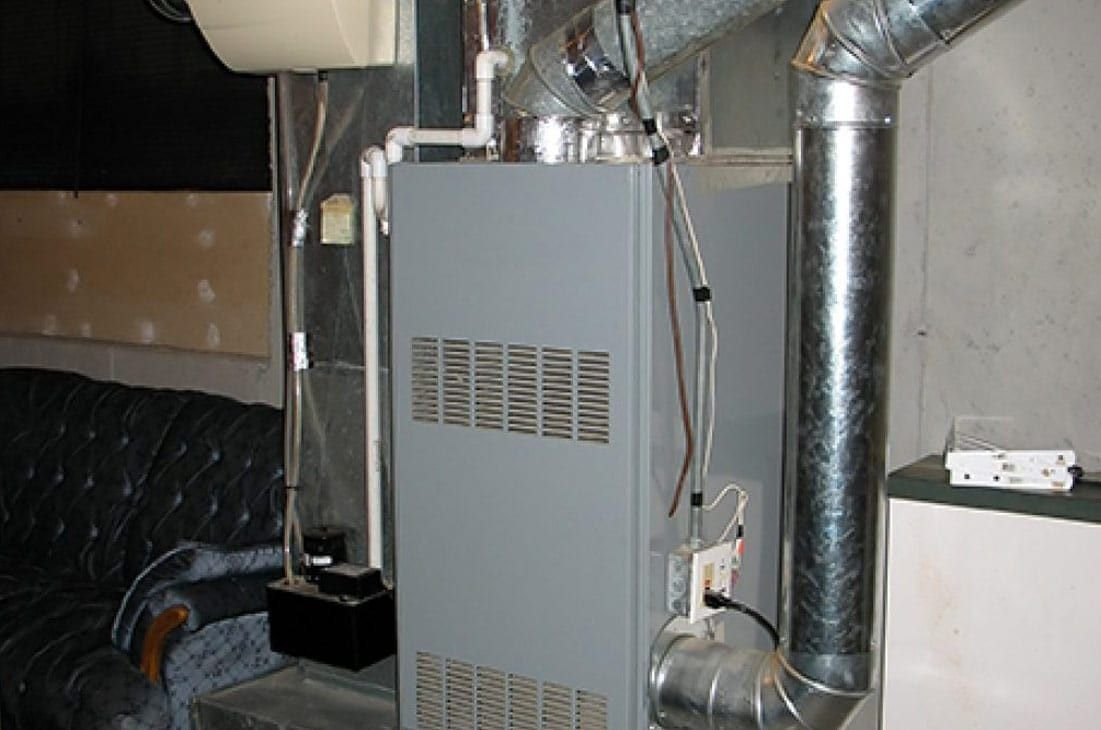
You can tell whether a furnace is upflow or downflow by looking at the furnace itself — the rating plate, the physical design of the cabinet, and the location of the burner and the blower relative to each other. The ductwork gives you a clue, but the furnace gives you the answer. The rating plate on the inside of the front panel lists the approved orientations. The model number often encodes the airflow direction. And the internal layout — whether the blower is below or above the heat exchanger — reveals the airflow path even if the rating plate is missing or unreadable.
This approach is complementary to tracing the ducts. The ducts tell you which direction the air is currently flowing. The furnace tells you which direction the air is designed to flow. Both should agree. If they do not — if the ducts suggest downflow but the rating plate says “upflow only” — the furnace was installed in an orientation for which it is not listed, and it is unsafe to operate.
Contents
- 1 Method 1: Read the Rating Plate — 100% Definitive
- 2 Method 2: Decode the Model Number
- 3 Method 3: Look at the Internal Layout
- 4 The Condensate Drain as a Clue — Condensing Furnaces Only
- 5 FAQ: Common Questions About Furnace Direction
- 6 The Rating Plate Is the Final Word. Everything Else Is an Indicator.
Method 1: Read the Rating Plate — 100% Definitive
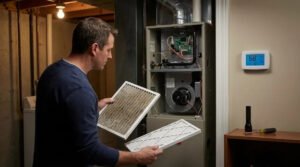
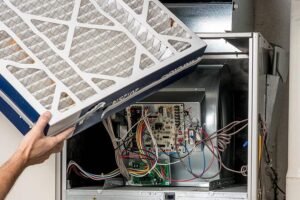
Turn off power to the furnace at the service switch. Remove the front panel — typically secured by two thumb screws or a spring latch. The rating plate is a metal or heavy plastic sticker on the inside of the panel or on the side wall of the cabinet. It lists the model number, serial number, BTU input, and — critically — the installation orientations for which the furnace is listed. The plate will say one of the following:
- “Upflow” or “Upflow Only” — the furnace can only be installed standing upright, return at bottom, supply at top.
- “Downflow” or “Downflow Only” — the furnace can only be installed with return at top, supply at bottom.
- “Upflow / Horizontal” — the furnace can be installed upright or lying on its side, but not downflow.
- “Multi-Position” — the furnace can be installed in any orientation: upflow, downflow, horizontal-left, or horizontal-right.
The rating plate is the manufacturer’s legal certification. It overrides the visual evidence of the current installation. A furnace installed in a basement with the ducts running upward — suggesting upflow — that has a rating plate listing “Downflow Only” was installed incorrectly and is unsafe. The rating plate, not the installation, defines the furnace type.
Method 2: Decode the Model Number
Furnace model numbers often encode the airflow direction. The encoding is not standardized across manufacturers — each manufacturer uses its own code — but common patterns exist. An “U” in the model number typically indicates upflow. A “D” indicates downflow. “UH” or “UHX” indicates upflow/horizontal. “DN” or “DF” indicates downflow. Manufacturers that use numerical codes may use “1” for upflow and “2” for downflow.
| Model Number Contains | Likely Airflow Direction | Example Models |
| U (standalone) | Upflow | Carrier 58STA, Goodman GMES80 |
| D, DF, DN | Downflow | Goodman GMES80-D, Trane S8X1D |
| UH, UHX | Upflow / Horizontal | Goodman GMES96-UH, Carrier 59TP6-UH |
| M, MP, Multi | Multi-Position (all four orientations) | Trane S9V2-M, Lennox EL296V-M |
The model number is an indicator, not a confirmation. Verify against the rating plate. A model number that suggests upflow does not override a rating plate that says downflow.
Method 3: Look at the Internal Layout
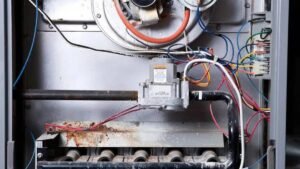
If the rating plate is missing or unreadable and the model number is ambiguous, the internal layout of the furnace reveals the airflow direction. In an upflow furnace, the blower is in the lower portion of the cabinet and the burner — with the gas valve and the gas manifold — is in the upper portion. The return air enters at the bottom, is pulled upward through the blower, and is pushed across the heat exchanger in the upper portion before exiting the top. The burner is above the blower.
In a downflow furnace, the layout is inverted. The blower is in the upper portion of the cabinet and the burner is in the lower portion. The return air enters at the top, is pulled downward through the blower, and is pushed across the heat exchanger below before exiting the bottom. The burner is below the blower.
The burner is the easiest component to locate without removing panels: it is the metal tube assembly with the gas valve attached. In an upflow furnace, the burner is at the top third of the cabinet. In a downflow furnace, the burner is at the bottom third. The burner location tells you the furnace type. Burner at top = upflow. Burner at bottom = downflow.
The Condensate Drain as a Clue — Condensing Furnaces Only
On a condensing furnace, the condensate drain exits the furnace near the secondary heat exchanger, which is always downstream of the primary heat exchanger. In an upflow condensing furnace, the secondary heat exchanger is in the upper portion, and the condensate drain exits near the bottom of the cabinet — the water drains downward by gravity. In a downflow condensing furnace, the secondary heat exchanger is in the lower portion, and the condensate drain exits near the bottom of the cabinet as well. The drain exit location is similar in both configurations, making it a poor indicator of airflow direction. Do not rely on the condensate drain alone.
FAQ: Common Questions About Furnace Direction
What if I cannot remove the panel to read the rating plate?
Look at the model number on the outside of the cabinet — many furnaces have a sticker on the side or the front that includes the model number without requiring panel removal. If the model number is not visible, the furnace’s location tells you 95% of the time: basement = upflow, attic = downflow or horizontal, crawlspace = horizontal. For more detail on location-based identification, see the companion guide on this site that covers duct-tracing and location methods.
My furnace is installed horizontally. Does that mean it is a horizontal furnace?
Not necessarily — it means the furnace is installed horizontally, which it can be if it is a multi-positional or upflow/horizontal furnace. The furnace type is determined by the manufacturer’s rating, not the current installation. A furnace installed horizontally with a rating plate that says “Upflow/Horizontal” is correctly installed. A furnace installed horizontally with a rating plate that says “Upflow Only” is dangerously installed. Verify the rating plate. The installation must match the listing.
The Rating Plate Is the Final Word. Everything Else Is an Indicator.
The rating plate on the inside of the furnace front panel lists the approved installation orientations. It is the definitive answer. The model number, the burner location, the ductwork direction, and the furnace location are indicators that suggest the answer but do not override the rating plate. A furnace installed in a basement with the supply duct running upward is almost certainly an upflow furnace. The rating plate confirms it.
Before replacing a furnace, verify the rating plate. The replacement furnace must be listed for the same orientation as the existing furnace — or the ductwork must be modified to accommodate a different orientation, which adds $3,000 to $6,000 to the installation cost.